
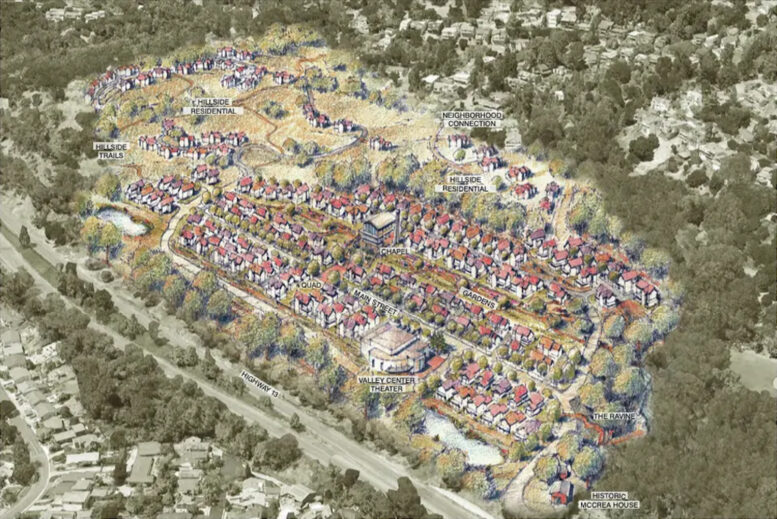
Zoning permits have been filed with detailed plans for the redevelopment of the Holy Names University campus at 3500 Mountain Boulevard in the Oakland Hills. The suburban proposal will preserve the existing chapel, bell tower, and performing arts center while replacing the rest of the campus with 165 single-family homes. Los Angeles-based real estate developer BH Properties is responsible for the project after purchasing the campus for $65 million in 2023.
The pre-application invokes Senate Bill 330 to streamline the approval process and freeze local zoning rules. The developer had previously stated it was their intention to “continue the educational tradition of the HNU Campus,” but has pivoted to housing after struggling to attract a new university. According to San Francisco Chronicle reporter J.K. Dineen, BH Properties is working with Tidewater Capital on this latest application.
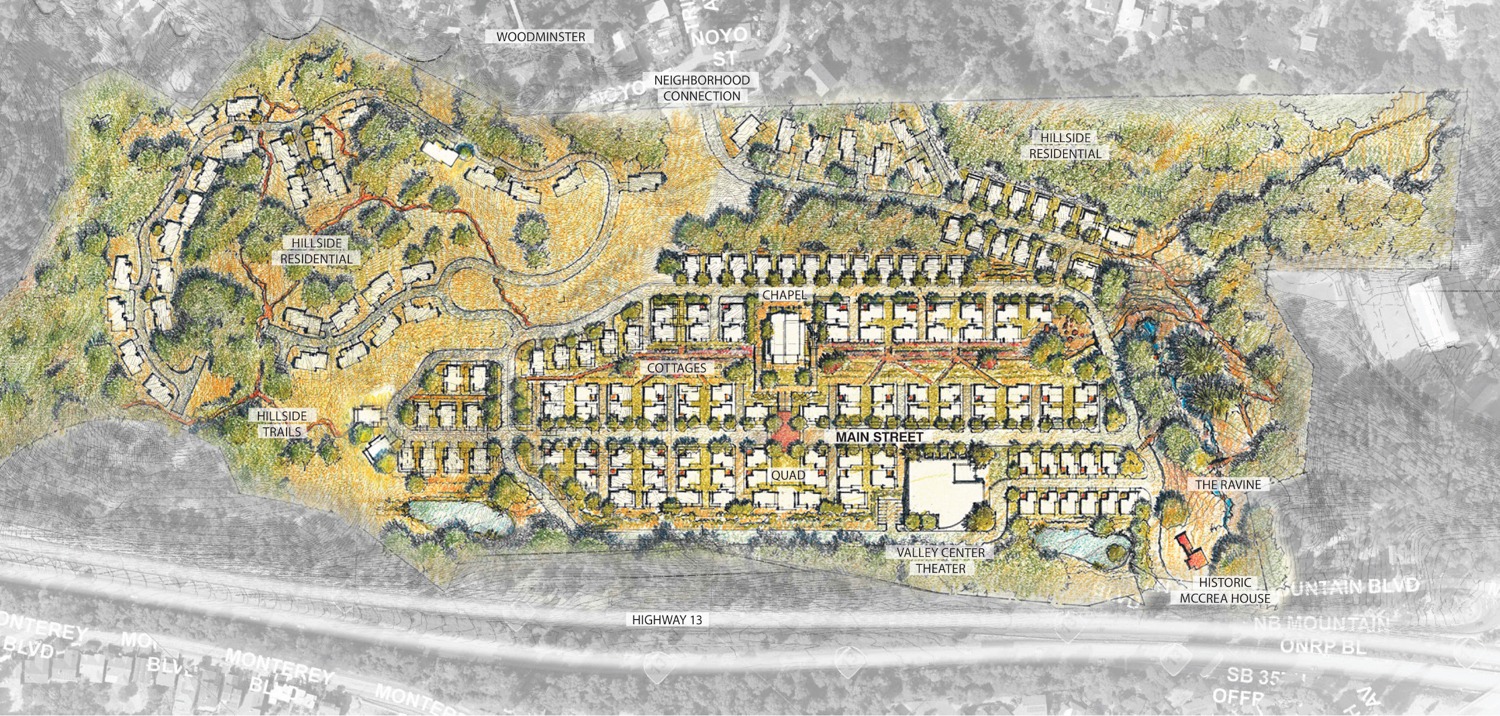
Holy Names University campus redevelopment site map, illustration by Bull Stockwell Allen
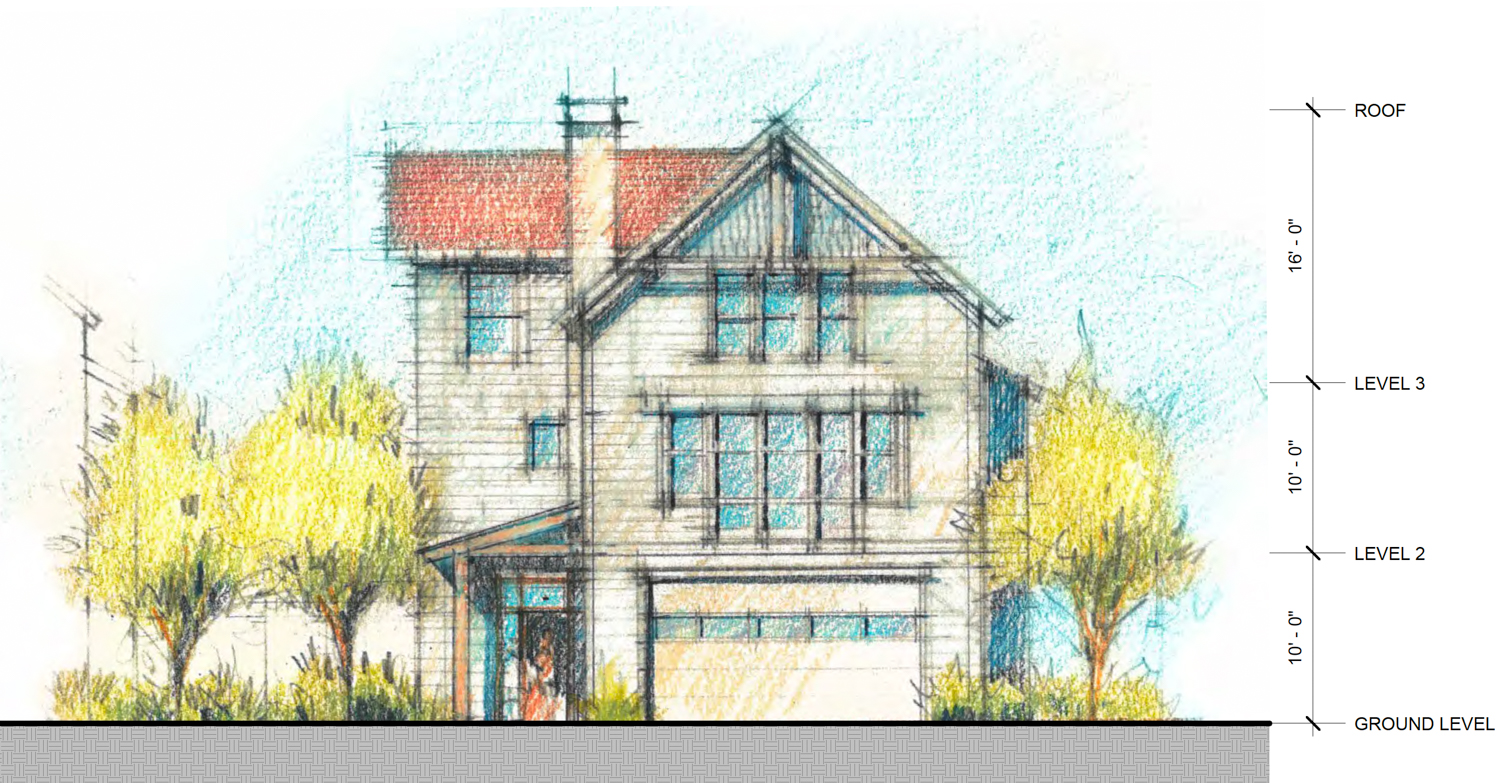
Holy Names University campus redevelopment large cottage house, drawing by Bull Stockwell Allen
The application, drafted by Reuben Junius & Rose LLP, asserts that existing law permits residential use without restrictions based on the Institutional General Plan designation. This is an argument that the city appears poised to dispute, as the language in question states, “under certain conditions, mixed-use housing and commercial development that supports these institutional areas may be allowed.” While Reuben Law states that the language ‘runs afoul of the ‘Housing Accountability Act,’ the city wants to retain the campus as an educational facility, as reported by Hannah Kanik for the San Francisco Business Times.
The SB 330 pre-application filing states that at least 5% of the neighborhood will be deed-restricted for very low-income households. Conversely, the plans do not utilize the State Density Bonus law to increase potential residential capacity.
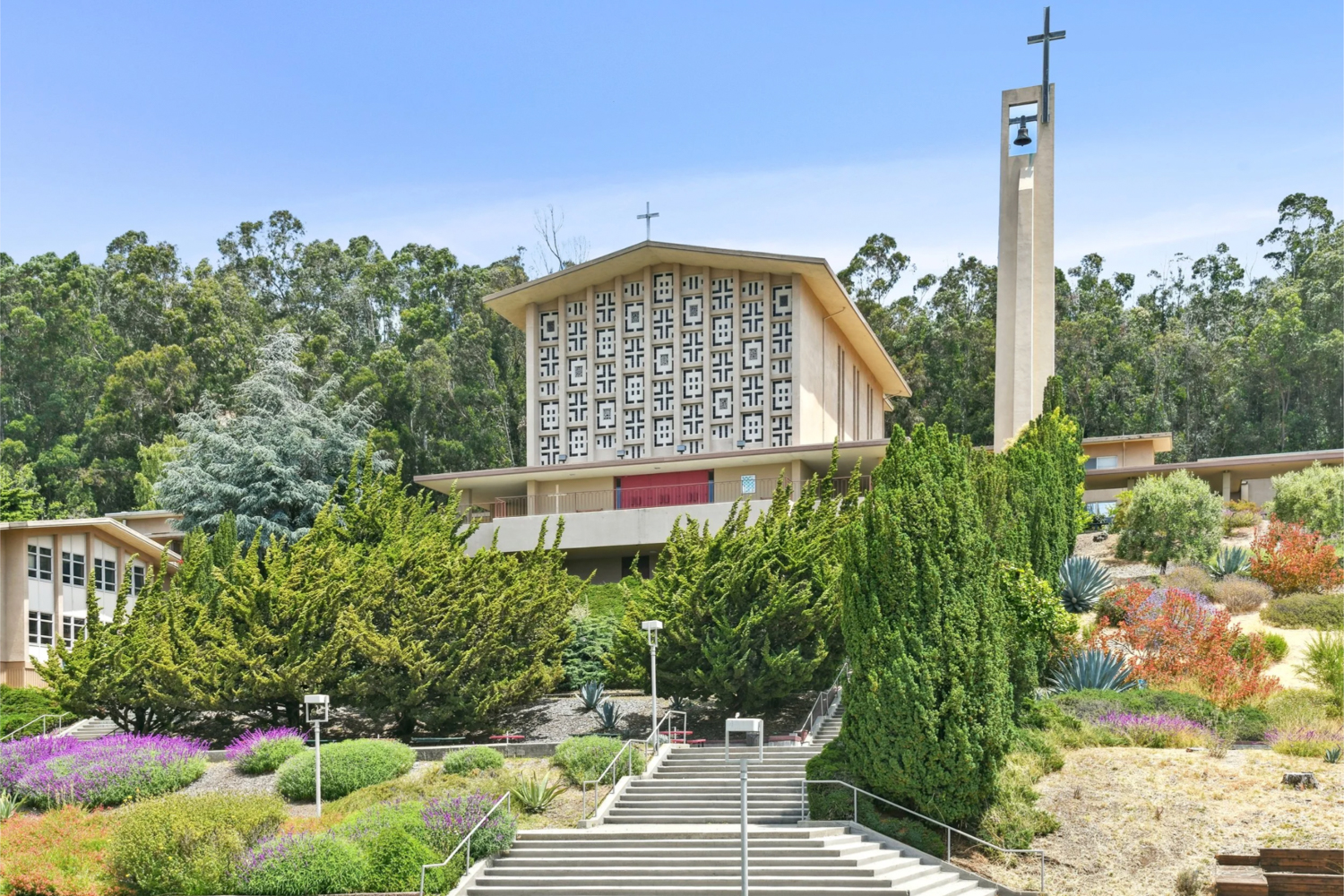
Holy Names University chapel, image courtesy BH Properties
The preliminary plans call for the construction of 165 detached single-family homes across the campus, including 37 larger hillside homes overlooking small and large cottage-style homes. The central circulation road will loop around the preserved midcentury modern McLean Chapel Building, bell tower, and the 400-seat Valley Center Performing Arts Building. The 1913-built McCrea Building, a designated city landmark built by architect George McCrea, will also be preserved.
Bull Stockwell Allen is the project architect, with Design Workshop serving as the landscape architect. Each house will contain a two-car garage and two to four bedrooms. The exterior will be clad with stucco, painted wood shingles, and asphalt shingle roofing.
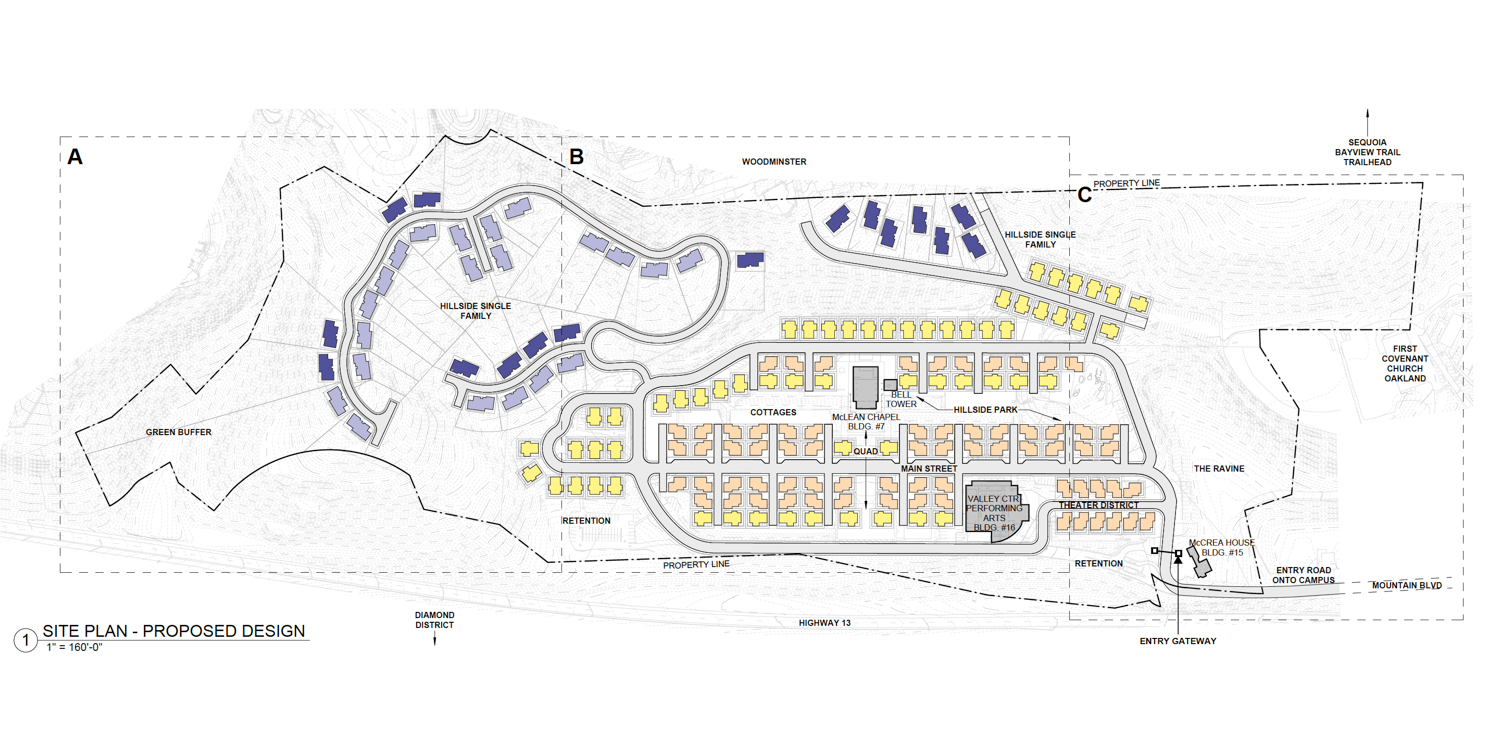
Holy Names University campus redevelopment map, illustration by Bull Stockwell Allen
Holy Names University was founded in 1868 as the Convent of Our Lady of the Sacred Heart. The school opened the Mountain Boulevard campus in 1958, with the design by Milton T. Pflueger, younger brother of the well-known Timothy Pflueger. The performing arts center was later constructed in 1994. The school shut down in 2023 due to rising operational costs and declining enrollment, and sold the campus to BH Properties in June 2023 for $65 million.
The roughly 58-acre property will be subdivided into 195 parcels, with 165 residential lots, and 30 parcels set aside for the preserved homes, streets, open space, utilities, and other facilities. Demolition is expected for 14 existing institutional structures. The site overlooks California State Route 13, uphill from the Dimond District and near the Merritt College campus.
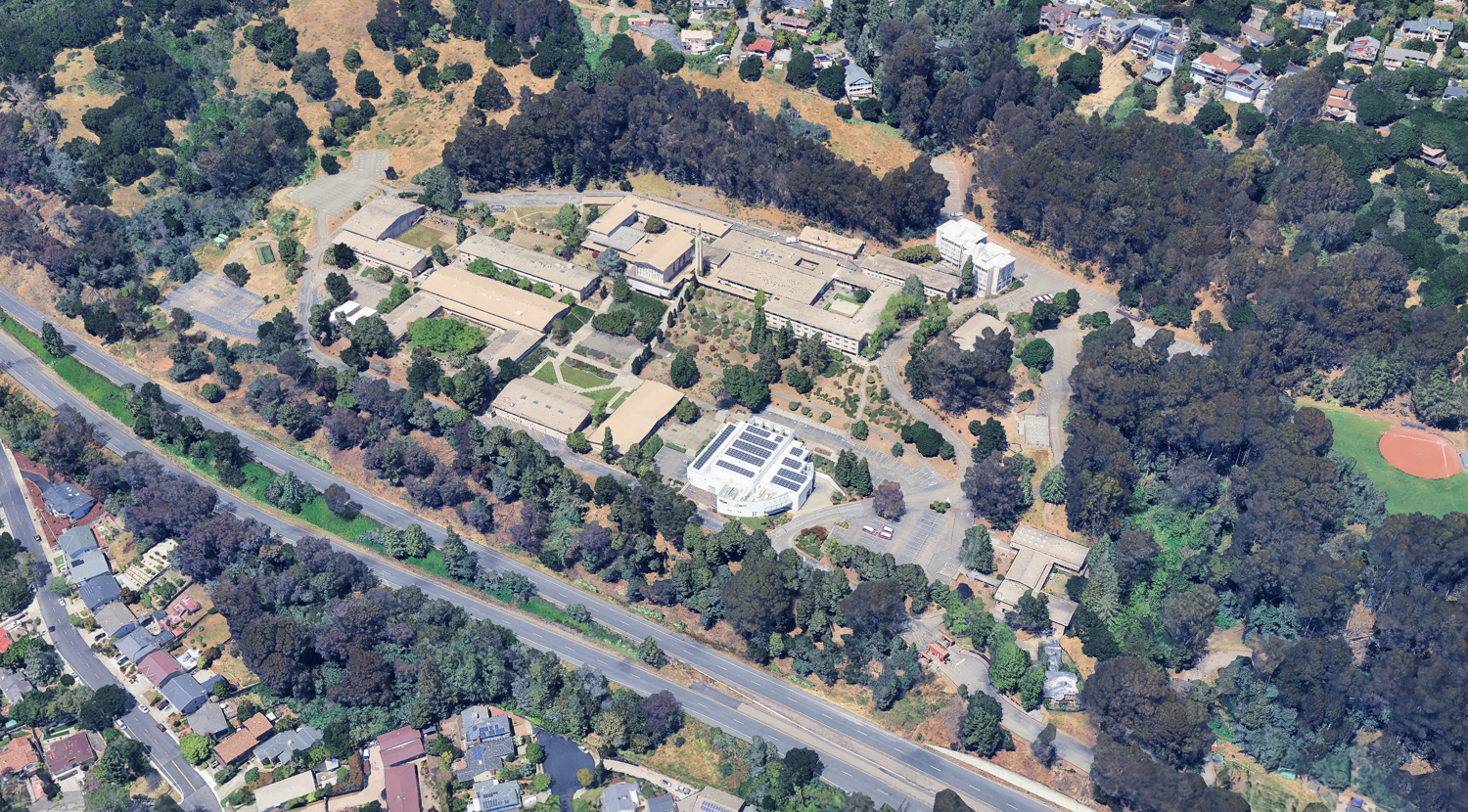
Holy Names University campus, image via Google Satellite
The estimated cost and timeline for construction have not yet been shared.
Subscribe to YIMBY’s daily e-mail
Follow YIMBYgram for real-time photo updates
Like YIMBY on Facebook
Follow YIMBY’s Twitter for the latest in YIMBYnews
Oakland should be begging them to redevelop this site as housing. We were lucky that Mills was kept open as a campus, but there’s a reason that CCA and Holy Names both closed. This campus sits as close to an earthquake fault as can be without actually being directly on top of it, and would require tens of millions to make any institutional use possible which makes it doubly impossible. In fact, it’s surprising that the city allowed Holy Names to operate in such earthquake susceptible buildings as it was. Oakland should take the win and approve the housing.
165 homes at a value of $2M each or more. Nice little property tax bump for the city of Oakland. Next, they need to work on consolidating down their public school footprint and selling those properties at market rates to developers. Oakland has way, way too many public schools and is spineless when it comes to closing them, bowing to neighborhood pressure every time. For example, Montclair Oakland has Thornhill, Montclair and Joaquin Miller elementaries…for a neighborhood that is now heavily empty nesters who are retiring in place.
“Nice little property tax bump for the city of Oakland.”
Those cul de sacs are definitely not going to provide enough local tax revenue to pay for their long term infrastructure maintenance and replacement costs. In the long run those parts at least will definitely be a new tax drain on the city.
Really “Housing Accountability Act” Oakland would be foolish to try to deny this new plan, I see this as a win!
Nice plan — but it needs a convenience store if it wants to be a walkable neighborhood.
Nothing about this is designed to be a walkable neighborhood, it’s just more car sprawl. It’s going to make the overall Oakland population even more car-dependent.
There’s a Safeway and a CVS (among other shops and restaurants) less than a half a mile away in one direction, and a neighborhood market, hardware store, and other shops under a mile away in the other direction, so I’m not sure if a convenience store right in between would make business sense?
My question is: if they’re keeping the performing arts center, where would anyone park to utilize it? Or is it being re-purposed for a non-public use?
Forgive me for not being enthusiastic about more car-dependent post-war style detached home suburbia. The “Hillside Residential” section of this is just two more cul de sacs, aka government-funded driveways, that are useless to anyone that doesn’t live on them and will take more money to maintain in the long term than they will provide in local tax revenue. Cities should really ban new dead-end roads.
Do you just come here for your daily dose of annoyance? This isn’t some greenfield sprawl taking up farmland. My goodness, is anyone satisfied with anything?
Great Scott!
I wonder why all single family homes? Could they not sprinkle in some townhomes or small apartment buildings?
Where is the parking for the theater and the chapel? That is necessary for the community.
Urban sprawl. More streets that won’t be maintained. They want to connect it with the neighborhood above, have they bothered to look at those switchbacked potholed streets? No way can they support the 300+ cars this will bring in, even as a secondary entrance. Evacuating during a fire or earthquake would be next to impossible if this were allowed. Not to mention the loss of green space and habitat for wildlife. Once it’s gone, it’s gone for good. So short sighted.
The developers don’t care, they’re from LA.
I am concerned about egress from this site for 165 homes – there appears to be only one entrance/exit from Mountain blvd in a fire prone area.
A few months ago they closed the small Woodminster firehouse after the LA fires due to resource shortages. Now they want to build 165 homes on a 60-acre lot? That doesn’t add up — hillside development would increase wildfire exposure and evacuation burden in an already high-risk area with limited emergency capacity. I’m not opposed to redevelopment within the existing Holy Names campus footprint, but the hillside should remain open green space. Many residents moved here because of that open space; building on the hill would destroy a vital wildlife corridor and permanently change the character of the neighborhood.
Upon reviewing the comments and statements regarding this design proposals, I believe several alternative options for this expansion of housing should be submitted before final decision is made. Has anyone provided a cost analysis on how much property tax income is expected for the city of Oakland? if and when this new housing development proposal is approved for family and or student purchase. For those making the final decision you must take into consideration the comments and views of those who live in the Oakland Hills for decades. FIRE SEASON DANGERS must be on the table for discussion. THIS IS VERY A SERIOUS ISSUE! Roads are small.
Between destroying the wildlife corridor and increasing fire risk, hillside development is a disaster waiting to happen. It would make more sense to swap out the cottage-style homes for townhomes. And how can very low income buyers reasonably afford the very few homes set aside for them on this parcel? So many question marks.