
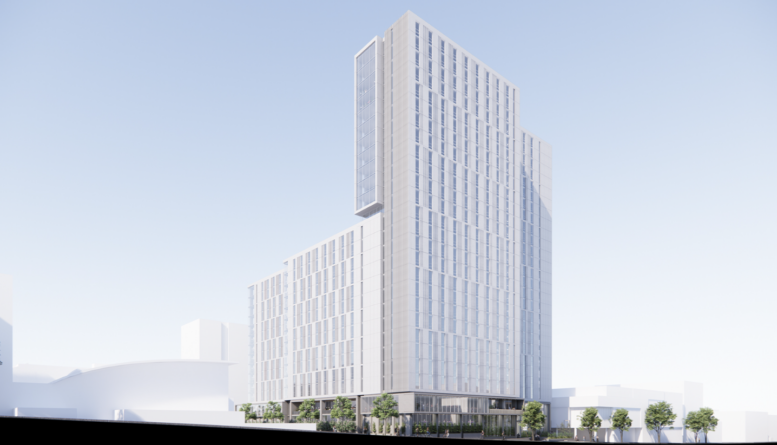
The University of California at Berkeley has made clear its intention to move forward with its largest-ever student housing project. The proposed building would reach 26 stories, rising 3 more above the university’s next largest project, currently under construction at Bancroft Way and Fulton Street.
The project, entitled the Channing-Bowdich Student Housing, would cover a nearly 2-acre site and provide approximately 550,000 square feet of dormitory space. University staff estimates that the facilities will be able to house as many as 1,500 students, providing much-needed relief to the current demand. The housing will accommodate primarily undergraduate students, and it plans to provide student services for dining, social, and recreation in line with the university’s other undergraduate housing.
SOM is responsible for the building’s full design and layout. Their plans currently require the partial demolition of the existing property and the integration of its remaining buildings into the larger housing complex. The new structures consist of a split height, with a full height 26-story building at the corner of Channing Way and Bowdich Street, and a 14-story addition stretching further along Bowdich. Early façade designs of the complex show a white and grey cement panel façade with patterned window placement.
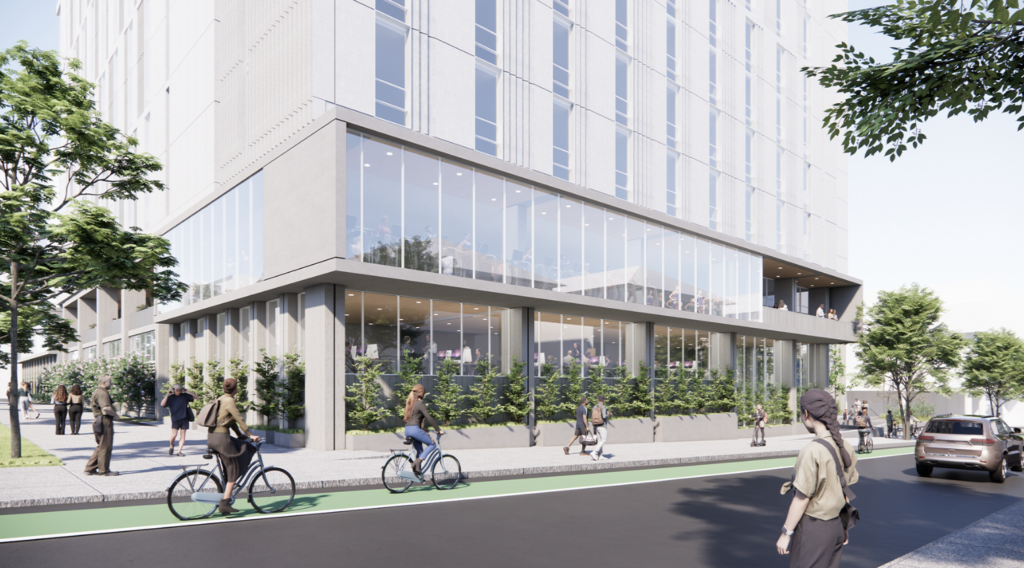
Channing-Bowdich Student Housing Streetview Rendering, image by SOM
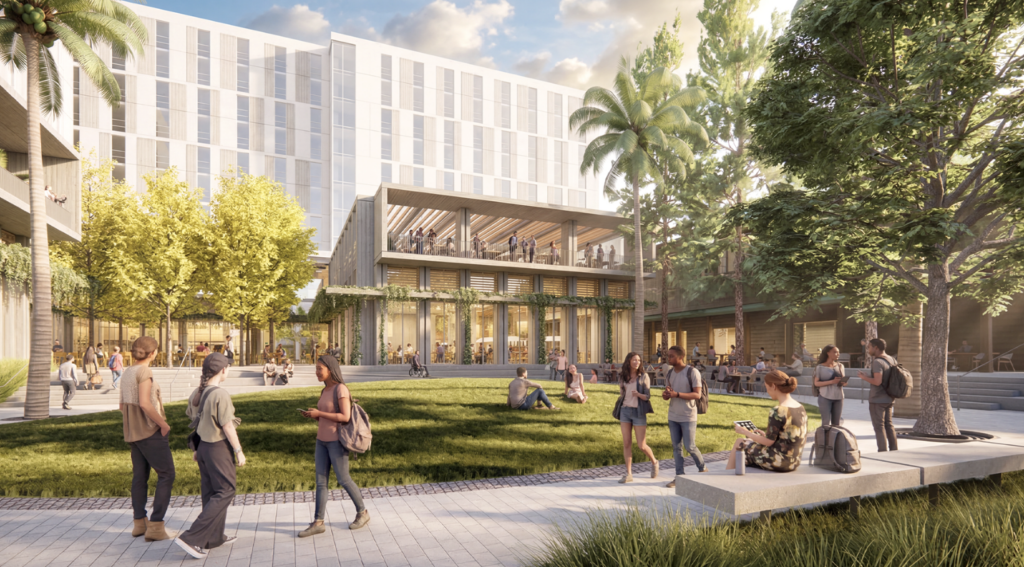
Channing-Bowdich Student Housing Courtyard Rendering, image by SOM
The first two stories of the buildings are to act as a podium, and they will contain the majority of the student amenities for the site. Design for the base floors is shown as prioritizing light and visibility, with floor-to-ceiling windows and an inset façade. In addition to the indoor spaces, the new complex plans to include an outdoor courtyard space and garden area for the students’ use.
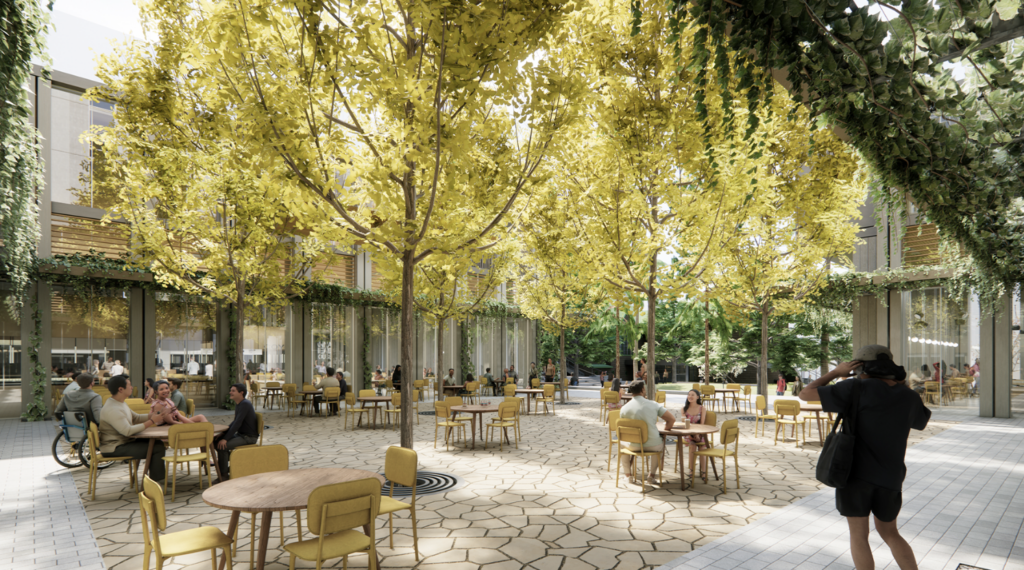
Channing-Bowdich Student Housing Patio Rendering, image by SOM
The site’s plans are being promoted by the university as a high-quality solution to the high demand for more student housing. However, there have been some community pushes back against the project. Specifically, preservation-minded community members are concerned about the partial demolition and adaptation of the historic Anna Head School for Girls buildings that are located on the site. While the project plans to partially preserve some of the buildings, there will be significant changes made.
UC Berkeley staff chose the site in spite of the raised concerns. The already dense area in Berkeley’s Southside has more limited options for the type of large-scale development demanded by the need for student housing. However, it remains desirable because of its high accessibility, many student-friendly businesses, and a generally social environment. The university likely believes that these many benefits are what make the project worthwhile.
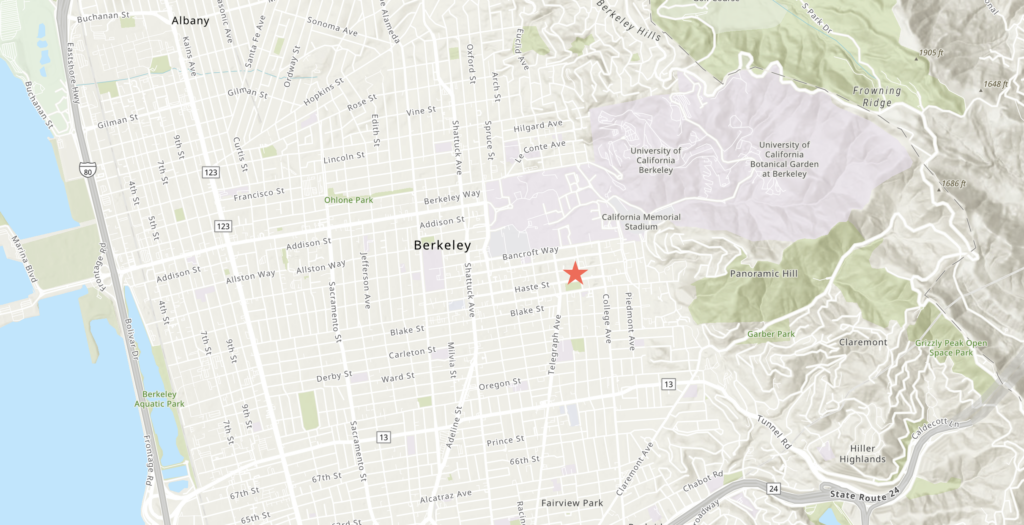
Channing-Bowdich Student Housing Site Location, image via ArcGIS Online
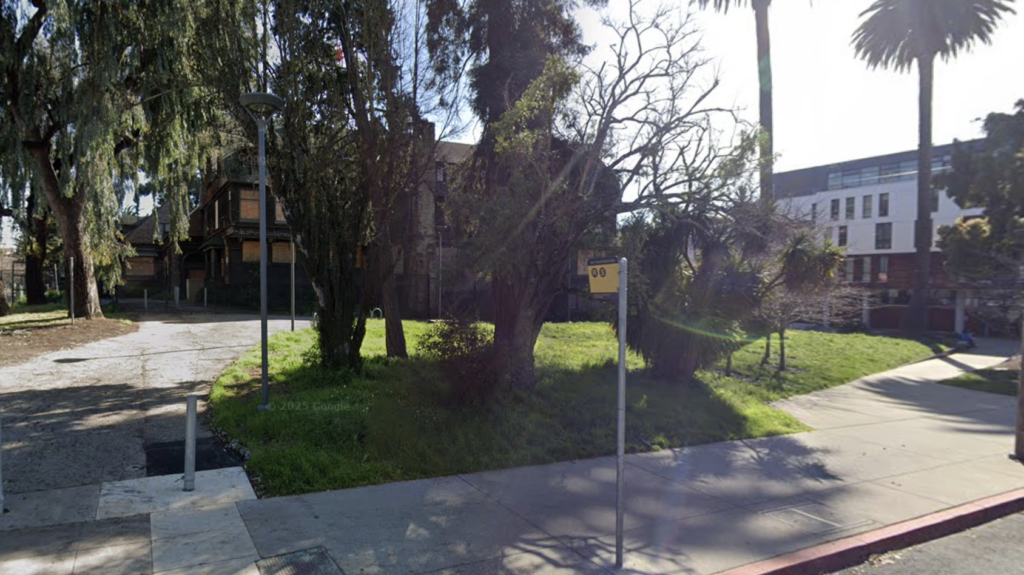
Channing Way and Bowditch Street Current Site, image via Google Street View
Subscribe to YIMBY’s daily e-mail
Follow YIMBYgram for real-time photo updates
Like YIMBY on Facebook
Follow YIMBY’s Twitter for the latest in YIMBYnews


It is highly misleading to call this a “partial demolition and adaptation” of that building. The key part of that building is being completely demolished and the rear annexes are being “preserved.” This would be like demolishing a historic mansion but re-using a carriage house in the backyard. It is doubtful that what they’re “adapting” as part of this project would retain any historic integrity, probably wouldn’t be a historic resource anymore, and could get demolished without oversight at the first opportunity. If they demolish the main building they might as well scrape the site there’s not much point in “adapting” those halls at the rear.
That main building isn’t one of a million little Queen Anne cottages or quirky but unimportant survivors, by the way. I know what website I’m commenting on here – but that main building is genuinely a work of art, and one of the best examples of its kind on the west coast. It would be the biggest loss in the area since the 60s/70s, when we didn’t have any preservation law at all. That is the part of the building they should be preserving – by moving the building closer to Channing Way, there would be more than enough room to build their tower. This project can both preserve the historic resource and build hundreds of dormitories – but they aren’t. They’re taking the easiest way out and greatly stretching the definition of “preserving” to throw a bone to critics.
* The “partial demolition and adaptation” quote is not the SFYimby Editor but from the source, don’t mean to throw shade at Mr. Clark-Clough.
It appears to be a boarded up building in rough shape (per Google Streetview photos from 2025). Restoring it to good condition would take many millions. Moving it (to where?) would cost quite a bit more. It’s a relatively small building on a very large lot two blocks from campus. If a philanthropist wants to step it, move it and refurbish it, so be it, but don’t stop progress. No one will remember or care that this building existed 20 years from now.
It is the responsibility of the property owner to maintain these historic buildings. The property owner is UC Berkeley – and has been since 1950. It is completely on the fault of the university that the building is in need of such repairs – the funding for repairs are available through a plethora of grants from the state Office of Historic Preservation that the university has chosen not to pursue for 70 years as the building’s condition has worsened.
If you had read my comment – I clearly said “move it closer to Channing Way.” That’s shifting it over on the same block a dozen or so feet. The proposed building’s footprint easily fits on the remainder of the block.
Did people also say that nobody would remember Penn Station? Or the City of Paris building in SF? Or hell, bulldoze all of downtown Berkeley – the City of Santa Clara bulldozed eight blocks of their thriving downtown in 1962 for the sake of “progress” too! Nevermind that it got replaced with a strip mall and a parking lot, and never mind that this building could be saved and still build all the housing they’re proposing.
I strained a ligament stretching to comprehend the analogy to Penn Station.
UC Berkeley officials have said it would cost at least $30 million to renovate Channing Hall, and that the university would not have a use for the building if it was restored. Cal will finance the construction of the dorm using bonds that will be paid back with its future revenue, Gibson said, but there would be no such mechanism to finance the restoration of Channing Hall.
In a January response to the Landmarks Commission’s letter, Wendy Hillis, the university’s assistant vice chancellor and campus architect, wrote that UC Berkeley is committed to preserving historic resources, but added, “The campus is not a museum.”
I am inclined to agree with Vice Chancellor Hillis.
Our cities are becoming museums to the communities that once existed because we refuse to build enough housing for people to stay. Then we throw up a few murals and art when they’re gone. Our cities need to grow and adapt to changing human needs and economic conditions.
If it was so significant, Berkeley and/or UC should have preserved and maintained this building decades ago. We can’t hold housing for people hostage to decisions that aren’t being made for buildings that served those who have moved on. If preservationists care, they would have fixed it up a while ago, or they should move it now. Time’s up.
The idea that a world-class university would have “no use” for the main building if restored, while somehow finding a use for the portions of the building they will “preserve,” is just a blatant lie. They would have no use for it because they don’t care to consider one.
Furthermore, the idea that preserving a single building OFF CAMPUS while STILL building all the housing they want on that site somehow turns the campus into a museum is a farce. Stanford University is another world class university that balances historic preservation, adaptive reuse, and new construction without making up nonsense like this.
I agree, Berkeley and UC should have preserved and maintained this building decades ago. It is the legal responsibility of the property owner to maintain historic buildings. They didn’t, and are now being rewarded for their neglect. They have owned the building for the past 70 years.
If UC has a legal obligation to maintain this historic building, why was this obligation never enforced, and why are they allowed to demo it? What utility does the historic landmarking serve if such singificant buildings as this are allowed to fall through the cracks?
To clarify, I am also sympathetic to many historic buildings and the fact that large intutions and governments allow them to languish. There is one such histoic building in my neighborhood that I am furious the City is letting decay. I think moving the Anna Head School makes sense in light of the extreme need for housing here.
This is the crux of historic preservation. What do we do with, genuinely historic and beautiful buildings that don’t fit aesthetically or functionally into their modern surroundings. I looked up this building and it does look beautiful and it would be sad to see it destroyed. However, this is an urban downtown site next to a major university that has a major housing crisis driven by students. This lands highest value is probably as student housing since its so close to one of the renowned and popular universities in the whole world. How to square that with the loss of something with real historic value is hard, but like Panhandle said, will anyone remember or mourn the loss of this building in 15, 20, 25 years? Probably not.
Take a picture of it and put it on your wall.
If it matters that much take lots of photos and videos so there’s a record of it. Otherwise get out of the way and let the place evolve.
Wow, something of an actual city fitting for the 21st century. Berkeley might have a chance to fight the hard-R doom-and-gloom of CA’s prosperity.
I hope this can get started swiftly. A society can’t claim to be progressive when even the highly educated struggle with homelessness. Every bed matters.
Glad to see this. We probably need a dozen more buildings of this size to adequately address student demand. People should remember that students not in dorms are bidding up rents for housing in other neighborhoods.
First off, UC allowed this building to decay to a deplorable extent….demolition by neglect, one might say. They did this.
Second, this is one of the most important landmarks of the First Bay Region Tradition – it is central to Berkeley’s heritage. It is a Berkeley City Landmark and it is listed in the National Register. To demolish it implies that none of this means anything.
The university has already destroyed People’s Park, another property on the National Register.
At the very least, the university should pay to move this building. F’in’ vandals. Next they’ll be wanting to tear down Maybeck’s First Church of Christ Scientist or Julia Morgan’s Women’s Club so they can stuff in more rich overseas students, instead of educating Californians.
I’m surprised it’s legal to be a City Landmark or be on the National Register and then let it decay. Not sure what/who the enforcing body would be, but it just feels…wrong. If you get the title, you probably get tax benefits, but should be required to maintain it. Failure to maintain should result in removal of title and loss of tax benefits. Sad!