
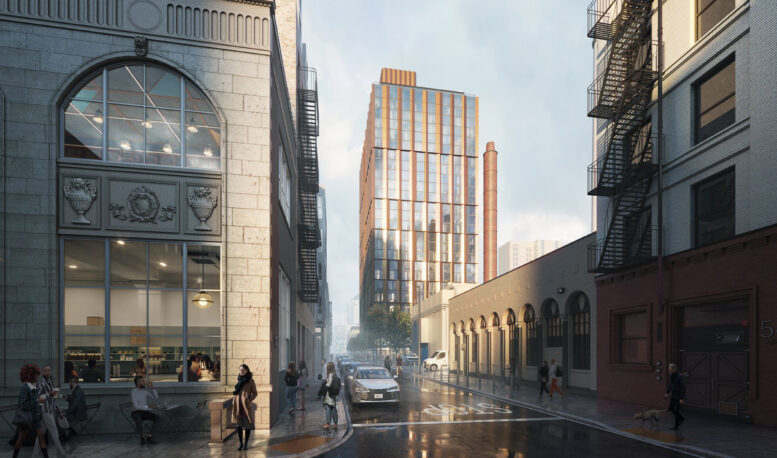
Entitlement extension has been requested for the 27-story residential proposal at 469 Stevenson Street in SoMa, San Francisco. The project was given a three-year entitlement approval in April of 2023, but construction never started, and the lot remains a surface parking lot. Build Inc is the project sponsor.
The planning process for the 27-story proposal began with the filing of initial applications nearly a decade ago in 2017. The project was approved in 2021, but an appeal filed by TODCO was upheld, and the process stalled. The Board of Supervisors granted approval again in 2023 with expectations of imminent construction, but the project stalled, with the developer publicly citing rising construction costs. In 2024, the city extended the conditional use authorization for public parking for another five years.
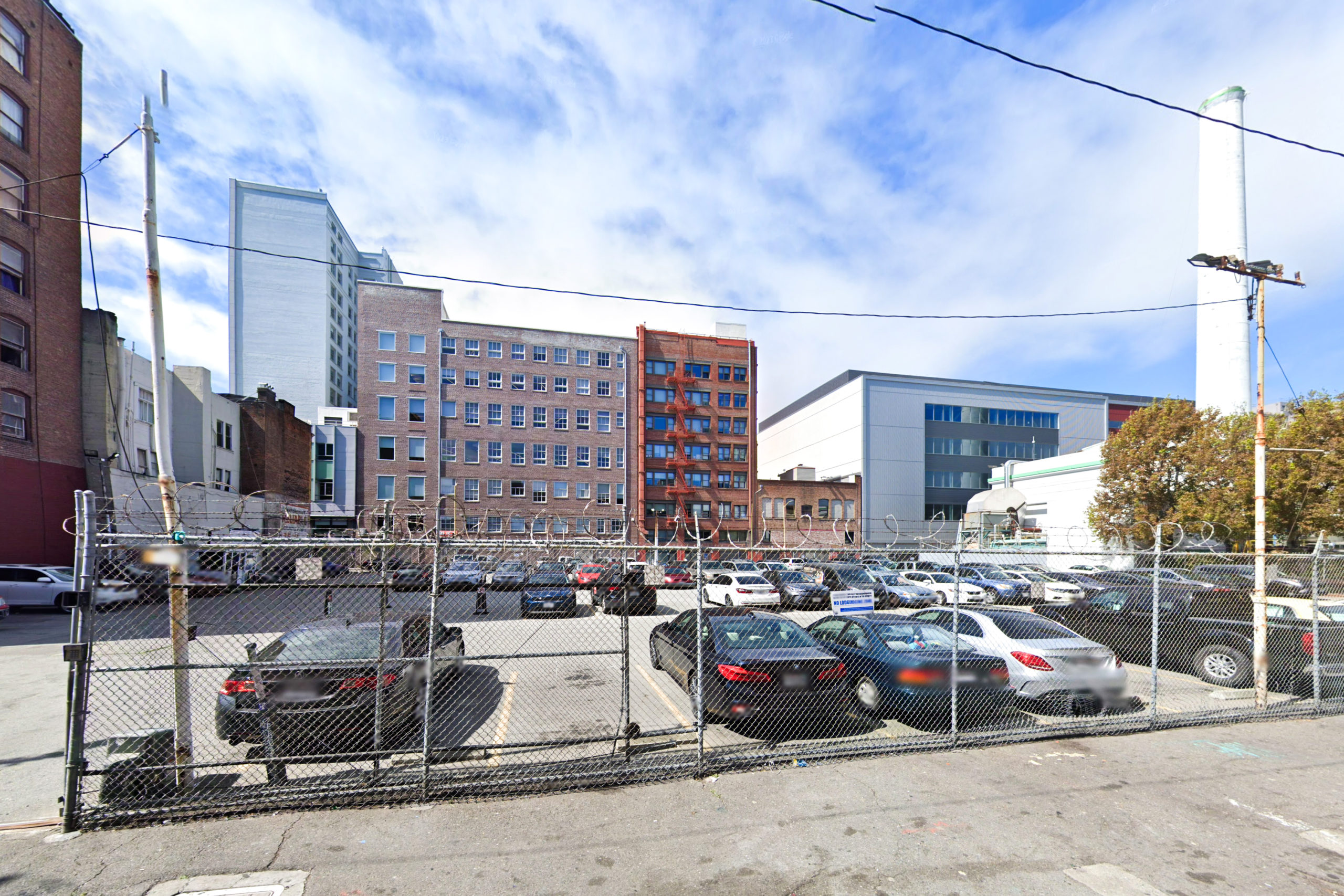
469 Stevenson Street, image via Google Street View
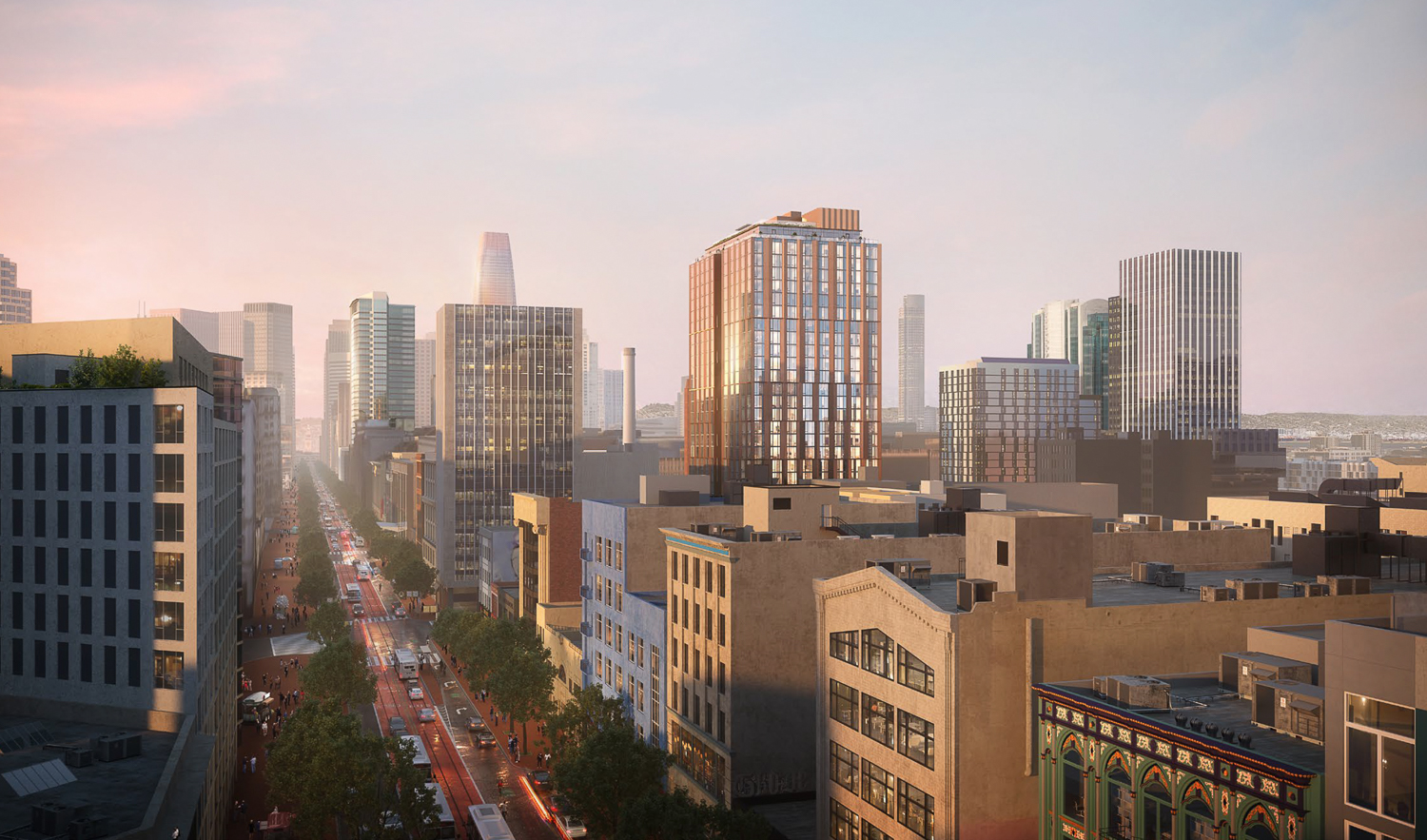
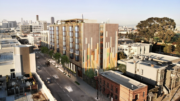
469 Stevenson Street aerial view, rendering by Solomon Cordwell Buenz
Managing Partner at Build Inc., Scott Eschelman, writes in the extension request that, “the need for an extension is due to the challenging San Francisco housing market compounded by restrictive financing conditions…”
The entitlement extension seeks to reduce the on-site inclusionary affordable housing from 19% down to 15%. The reduced quantity would still exceed the city’s requirement of just 12%. That is the only modification to the 2023 entitlement requested by Build Inc.
If built, the 290-foot-tall structure is expected to yield around 535,000 square feet with 425,640 square feet for housing, 3,990 square feet for retail, and 30,000 square feet of open space. Unit sizes will vary, with 192 studios, 149 one-bedrooms, 96 two-bedrooms, 50 three-bedrooms, and eight five-bedroom units. Parking is included for 178 cars and 227 bicycles. Bicycle parking will be included on the basement level, accessible from the garage or the lobby.
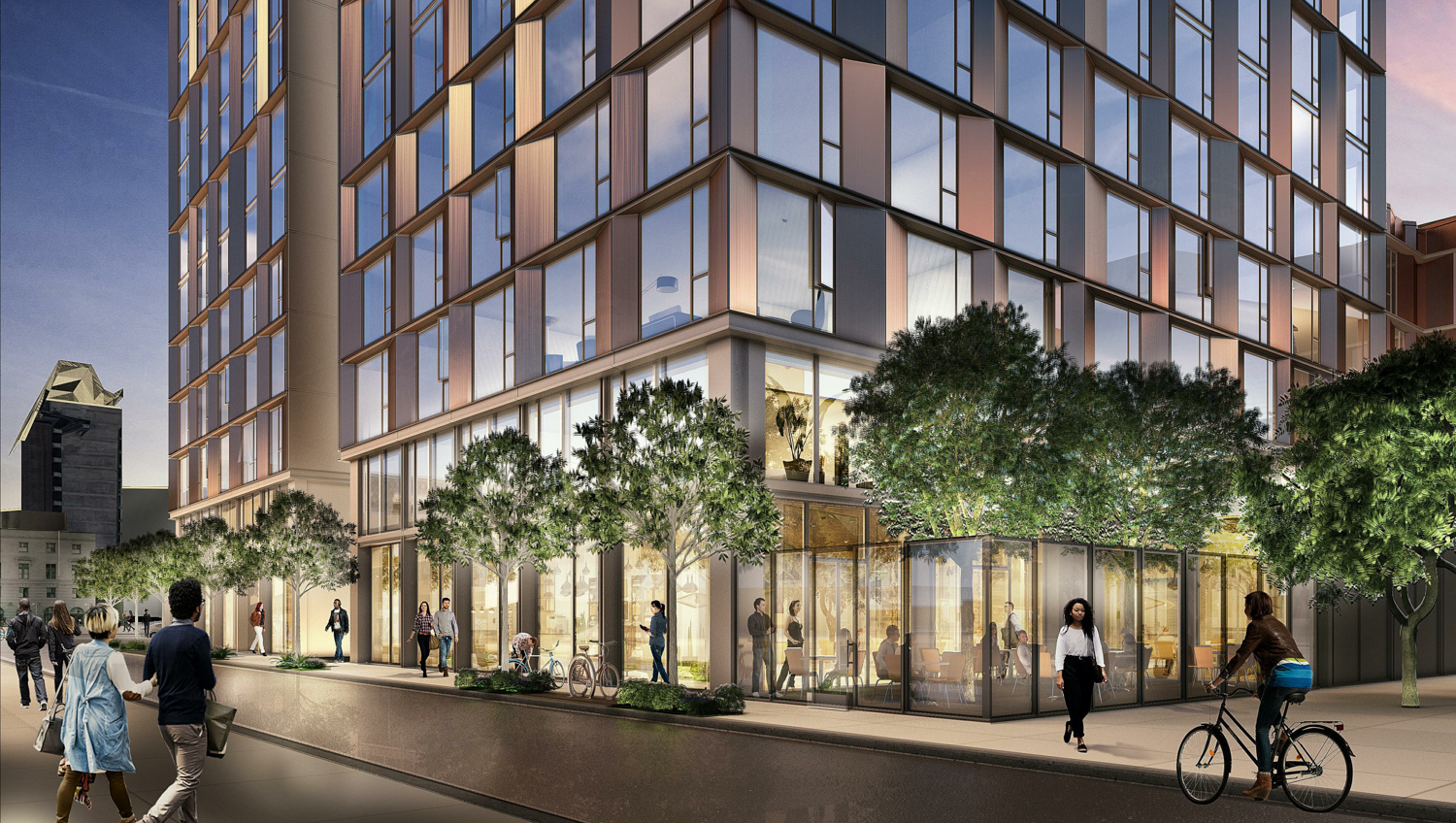
469 Stevenson Street street-level activity, rendering by Solomon Cordwell Buenz
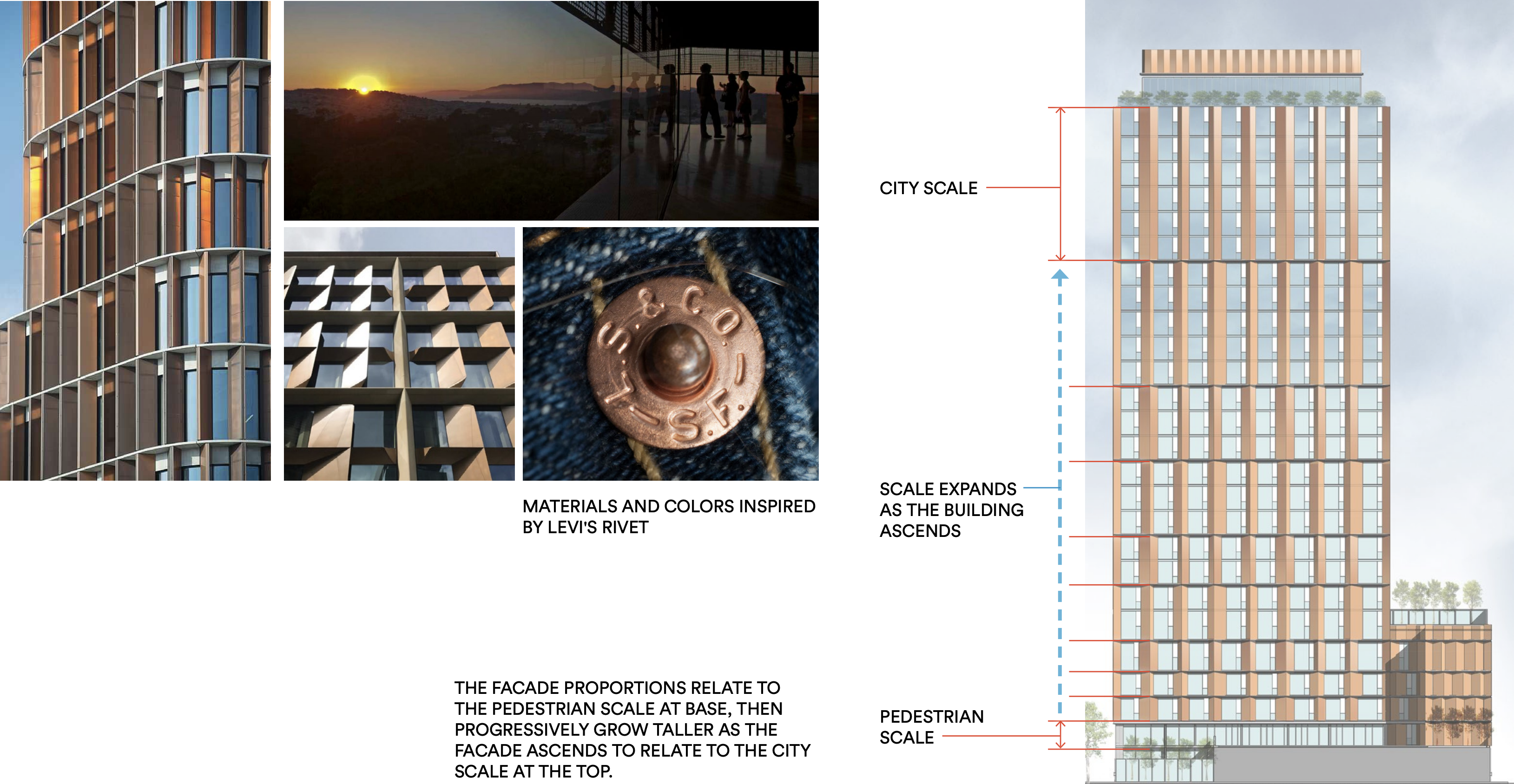
469 Stevenson Street design inspiration, rendering by Solomon Cordwell Buenz
SCB is the project architect, with landscape architecture by The Miller Company. The facade material takes inspiration from the copper rivets in Levi’s denim jeans. The building is clad with copper-tone metal panels between floor-to-ceiling windows.
The 0.66-acre property is located along Stevenson Street between 5th Street and 6th Street, and across from the IKEA-anchored mall. Construction is expected to cost over $200 million and last around 36 months from groundbreaking, though an estimated date for that has not yet been established. If approved, the updated entitlement would be valid until May 2029.
Subscribe to YIMBY’s daily e-mail

Follow YIMBYgram for real-time photo updates
Like YIMBY on Facebook
Follow YIMBY’s Twitter for the latest in YIMBYnews
If not for the regressive BOS from years ago this project would have been completed already, people would be living in that area, patronizing local businesses and helping to uplift the neighborhood and sustain businesses. Instead we have an empty parking lot, and businesses closing. We should never revert back to having a BOS with such ridiculous stances on housing.
Along with groups like TODCO having enough sway to knock thousands of units (hundreds in this case) off the calendar. We also lost BMR units in the process (which happens every time). It’s absolutely absurd and hopefully a relic of pre-pandemic NIMBY BS.
If the YIMBY useful idiots and the “pro housing activists” were serious about housing affordability, they’d be funding lawsuits to put a stop to tactics like this and speaking up loudly against entitlement extensions.
The developer had an approved project almost three years ago, did NOT request building nor demolition permits for the project when the approval was in hand, and now are back requesting continued operation of a surface-level parking lot. What’s to say they don’t wait another three years and then request another extension? Is a magic construction fairy going to appear and lower construction costs to the level of the developer’s liking?
YIMBYs need to be intellectually honest and admit that this tower is not being delayed due to San Francisco’s supposed arduous planning process. It wasn’t delayed due to the political power of organized incumbent homeowners coming to the dias at Planning Commission meetings, pounding the table saying “don’t build a 290-foot-tall tower in my back yard.”
It was delayed due to the developer’s own lethargy and inability to proceed with necessary haste.
Brahma, I would encourage you to read articles from 2021 back when this site was a hot topic in local politics. It absolutely was a case a classic NIMBYism: a small number of residents complaining about things like gentrification and shadows. The BOS even overruled the local supervisor (Matt Haney) to uphold the appeal and delay the project by at least a year. Time is money, and with economic factors changing it was no longer possible to build.
You say you’re opposed to an extension here – I’m curious what you would rather have happen? Is it better for it to be a parking lot forever? In a world where we’re not in a budget crunch I suppose the city could buy the site and build subsidized housing, but that’s a pipe dream at the moment.
“and with economic factors changing it was no longer possible to build”
LOL, so you admit that market rate housing only pencils out during a short period in the business cycle and therefore stipulate that financing for market rate housing dries up long before prices fall to anything close to what is classically defined as affordability.
In 2025 alone, the federal idiots turned this country upside down. My company couldn’t keep track of tariffs. Going from 0% to maybe 10%, then finalizing at a 6% price increase just for simply existing, does catastrophic damage to a project’s budget and timeline.
When a developer has a set amount of money to proceed with a project that reflects today’s prices and rates, but then they’re stuck in a multi-year approval process, you can’t account for every change. Labor costs increase, material costs increase.
News Flash! You need to be able to pay the base costs to construct ANYTHING. Whether it be market rate or affordable, the architects need a paycheck, the contractors have families, the plan checkers pay rent, and the consultants gotta eat. ALL of these build up the cost ecosystem, which is the construction industry. The margins of profit vary widely, and those leading the charge should be paid for a job well done. How big that margin gets can make things a little less immoral, but that’s another conversation.
This project was artificially delayed by NIMBY neighbors; it’s been ongoing since 2018. Need an example of how to appease the masses on market-rate housing? The MUNI bus yard project will NO LONGER provide any housing (affordable included). What’s less than 0?
Yes, when we have sky high labor costs, sky high material costs (not helped by tariffs), a byzantine permitting process that takes years and mountains of legal resources to navigate, and a massive amount of regulatory hurdles to overcome, housing is expensive to build. Plus, construction is a cyclical industry. If we delay projects when the financial conditions are favorable, we risk missing out on new housing altogether due to changing conditions. This is exactly what happened to 469 Stevenson and so many other projects in SF in the late 2010s/early 2020s.
But none of this means that market rate housing is inherently “unaffordable.” Look at anywhere in Japan, anywhere in the American sun belt, or even at San Francisco pre-1980. Market rate housing can be cheap, but only if we get out of our own way.
Tariffs are irrelevant, the biz cycle and cost of capital dominates here. It is not possible for a cyclical industry to regularly produce housing in sufficient quantities so as to push down price. Econ 101.
In Japan, infill housing is demolished and replaced every 30 years. The fiscal and regulatory environments are wholly different. In the sun belt, most construction is still car dependent sprawl in nature.
lol
It’s not the yimbys that are the issue
On-point comment here from Brahma. There are very good reasons that entitlements sunset in a limited amount of time. Granting extensions should be based on specific and unusual circumstances: otherwise the developer needs to fish or cut bait.
When they talk about labor and construction costs being so high, why does that only apply to cities like San Francisco? In places like Austin and Miami, there are massive cranes dotting the city skylines year round.
Of course the BoS doomed this project in 2021 – a major reason Dean Preston lost his re-election.
How much of these costs are due to city/state requirements to use union labor? My office tower in FiDi had to replace a doorknob, and the union that we’re forced to use for the work charged $20k. For one doorknob.
For some reason we aren’t allowed to even ask this question, and just assume it’s the cost of doing business here in this city.
YIMBY should just bring in H-1B for housing construction or maybe Uber, only for builders. Clearly YIMBY don’t want anyone who actually builds housing to live anywhere near that housing.
It is not like supply of construction inputs, labor, materials, professional services, can just scale to infinity. The more deregulation of land use controls, the more demand put on those inputs, which in their inelasticity and cause prices to build rise.
The things you mentioned are quite elastic. More people go into construction when things are being built.
YIMBY wants more housing for everyone. If that’s done via government subsidy, great. If done through the market, also great. Realistically we need a mixture of both. YIMBYism is simply the understanding that more housing is the only solution, and advocates for getting that supply however possible.
Now obviously without land value tax you’re going to have suboptimal outcomes, but we do what we can for now.
People are so afraid to admit the role of unions in skyrocketing labor costs. why? are you in a union?
if you think corporate monopolies are bad — wait till you understand the role of unions in our economy. literally the same thing.
“make sure you thank a union member for a 5 day work week”
ok – let me go back in my time machine to 1920 to thank them
we will never solve housing with this cancerous group setting artificially high labor prices.
California has deregulated housing statewide yet there does not seem to be any meaningful increase in construction capacity, hence rising prices. Sometimes, economic sectors will coerce scarcity to keep prices high. Econ 101. The cost of entry for construction is quite high. How many cement pouring machines can be produced and how fast, for example? Are they being produced? Or are they being kept scarce and monetized at higher rates?
The responses to my comment perfectly summarize the problem.
No one is willing to confront the real cost and problem of housing in this state.
It rhymes with munions.
So you want to pay construction workers less and put new residents at risk by mandating only single stairs?
Please, sir, may I have some more? Or will the beatings continue until morale improves? Is there anything else you’d like to deregulate? Asbestos, anyone?
Single stair buildings are ubiquitous around the world – except from the US. Are residents of Paris, Barcelona, Tokyo, London, etc. dying at much higher rates due to the lack of redundant staircases?
So Ben knows better than the fire prevention professionals just like Ben knows better than the economists who say that it will take decades if not centuries for the market to work its way towards affordability. By that time, we’ll all be Star Trek socialists and none of this will matter.
I, for one, rejoice in the continued existence of our beloved parking lot.
What is your preferred alternative to an entitlement extension for this project? What’s your proposal for something here that’s not a parking lot but can actually get financing right now?
I could really not care less what happens to that parking lot, because both market rate or affordable housing only serve the interests of those who build it, not those who live in it or those who live near it. Perhaps you’ll house a handful of families, but none of this will have the slightest bearing on housing prices for most everyone.
San Francisco has a demand crisis, too much, and there are public policy tools readily at hand to tamp that demand, while there are no policy tools at hand to coerce the construction of housing amidst macro economic tailwinds.
If we tax that which creates demand, then that will take pressure off of housing and everything else, lop off the high end of demand that inflates prices at the margin, and which will also diminish the need for government intervention to mitigate the economic impacts of wealth and income stratification.
What tf did you just type? 😂
Yes there’s high demand to live here: SF has fantastic weather, fantastic job opportunities, and a welcoming environment (especially for women, immigrants, and people of color). That’s a good thing, and in my opinion we should be celebrating that demand by building more housing and living up to our ideals of being a positive place of refuge for all sorts of people.
Your approach of putting up walls and trying to preserve the city in amber is what’s leading to skyrocketing rent – forcing so many people out of the city and to places like Texas and Florida. Note that those places are still affordable despite seeing big population increases – that’s what building a ton of housing does!
Demand is not high and reliable enough to keep housing prices rising at the level that will appease lenders who are not charity operations in YIMBY’s hurry to build.
San Francisco has long been desirable and expensive. When I moved here from Austin in 1989, since I was a programmer, I was one of the few of my friends who had an economic chance of making the move. This is when SF’s population was 773K. Another friend, a nurse also made move but didn’t like it and relocated to PDX 30 yr ago.
The only meaningful walls being put up here are those of lenders who put strict conditions on YOY ROI when they lend. Lenders are not in YIMBY’s hurry. You all should do something about that.
“Housing doesn’t serve the people who live in it.”
Lay off the bath salts my dude.
I thought that unleashing the magic of the market place would make markets more affordable to people rather than dribble out housing at a pace slow enough to sustain high prices, sucking as much money as possible out of “people who live in it.”