
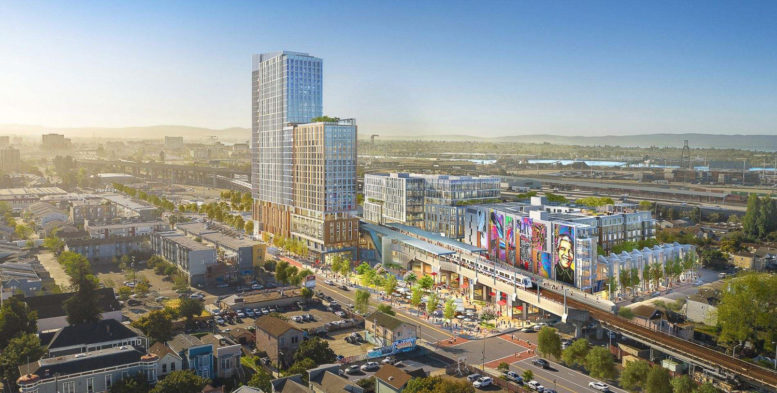
As per a recently released statement by BART, the long-awaited Mandela Station development project in Oakland is now taking initial steps towards construction. A portion of the West Oakland BART parking lot is closed this week for preliminary site soil testing and preparations. Site remediation, followed by building construction, is to begin later this year.
The massive development is planned to bring 762 new residential units, 300,000 square feet of office space, and 53,000 square feet of retail to the West Oakland neighborhood. The full scope of the project has been approved since 2019, but has stalled for several years. Despite the delays, the project was never discontinued, and the new development will be coming to West Oakland soon.
The project plans will encompass the total area of what is now the West Oakland BART parking lot. Project plans are broken down into four smaller development areas within the total site. Currently, BART has made no commitments on the timeline for full completion, and it is unclear whether the areas will be worked on sequentially or overlap with each other.
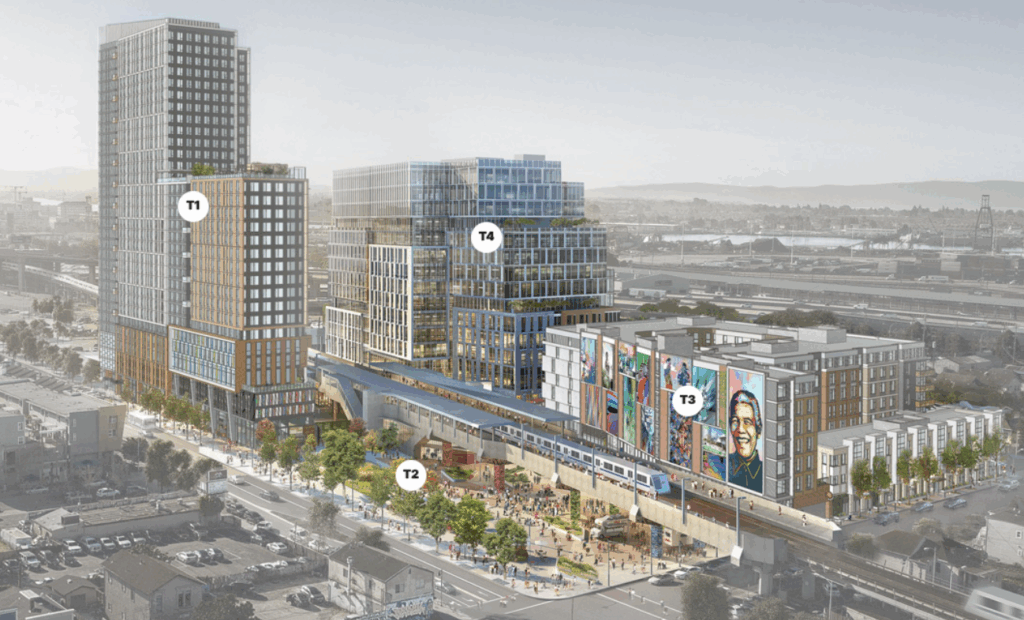
Mandela Station Development Area with Zone Labels, base image by JRDV Urban International
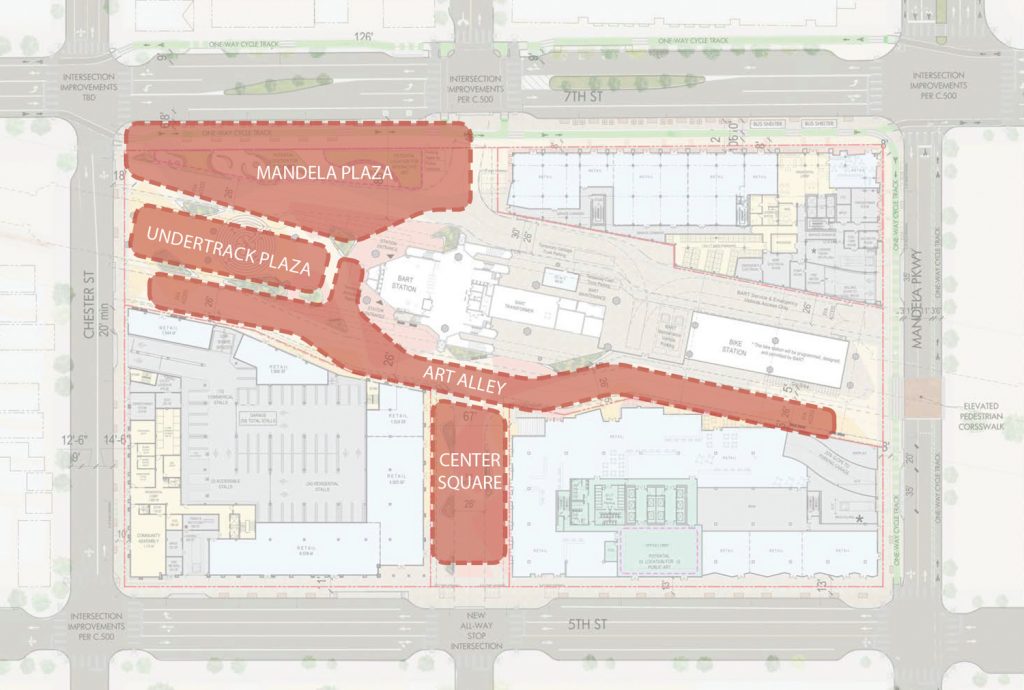
Parks within the Mandela Station development at 1451 7th Street, including Mandela Plaza, Undertrack Plaza, Art Alley, and Center Square, drawing courtesy JRDV Architects
Development Area T1 will consist of a 31-story high-rise building with 522 market-rate residential units and 14,350 sq ft of ground-floor retail space. Development Area T2 will focus on a Surface plaza and circulation improvements for the station. Development Area T3 will add a 7-story mid-rise residential building of 240 affordable multi-family units and approximately 16,000 sq ft of ground floor retail space. Lastly, Development Area T4 will construct a 100-ft-tall mid-rise commercial office building with 300,000 sq ft of office and approximately 23,000 sq ft of ground-floor retail space.
The full project is being brought by a team of development partners, named The Mandela Station Partners, and will include MacFarlane Partners, Pacific West, and Strategic Urban Development Alliance. Meanwhile, the design teams for the site include AO and JRDV Urban International.
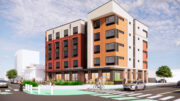
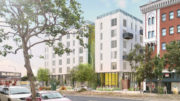
The designs they have brought include eclectic elements of modern architecture design, with each building holding its own unique flavor. The most recent renderings are from the T3 development zone, showing a bold, multicolored façade design on a blocky podium-style building. Window and balcony articulation are strategically placed to break up the building planes. Meanwhile, older renderings show the T4 development zone as a mostly glass façade with deep inset terraces, and the T1 development area as a slim mixed façade tower.
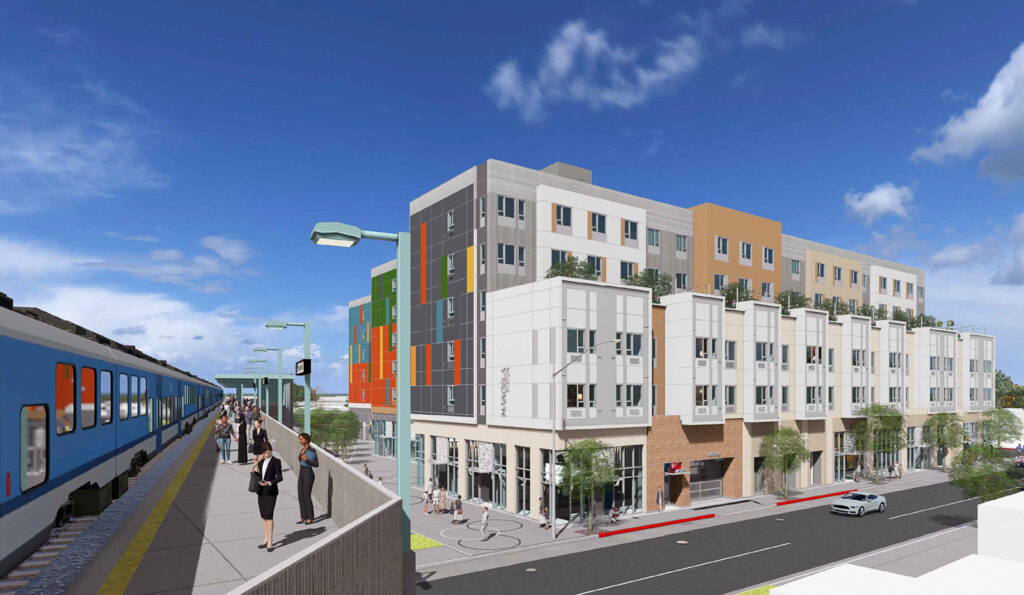
Mandela Station Parcel T3 seen from the West Oakland BART Station platform, rendering by AO
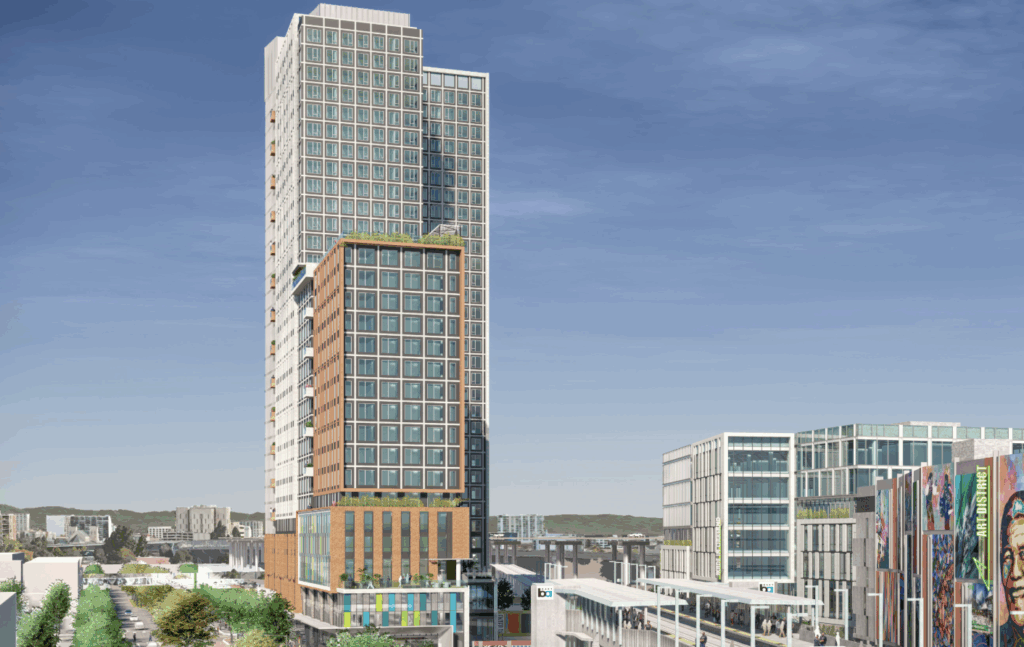
Mandela Station T1 Tower Rendering, image by JRDV Urban International
Taken as a whole, the development will be a significant increase in building density from the blocks immediately surrounding it. However, planners hope that the injection of new commercial and housing opportunities will help spark development across many of the vacant or underutilized spaces near the current project site.
The area around the project was once highly prosperous, a history supported by the large parks and beautiful Victorian homes spread across West Oakland. However, the area saw a steep economic downturn in the 1960s and onward, instigated at least in part by the construction of the Cypress Freeway in the decade before. After damage in the 1989 Loma Prieta Earthquake, the freeway was fully removed, leaving significant areas of land vacant, including those surrounding the West Oakland BART station. Rebuilding these areas is an important first step in restoring the area.
In recent years, Transit-Oriented Development has emerged as a method for cities to increase housing and commercial opportunities sustainably. This project at the West Oakland Bart Station will mirror others already completed or underway at MacArthur BART, Fruitvale BART, and Lake Merritt BART stations in Oakland, as well as others across the full network.
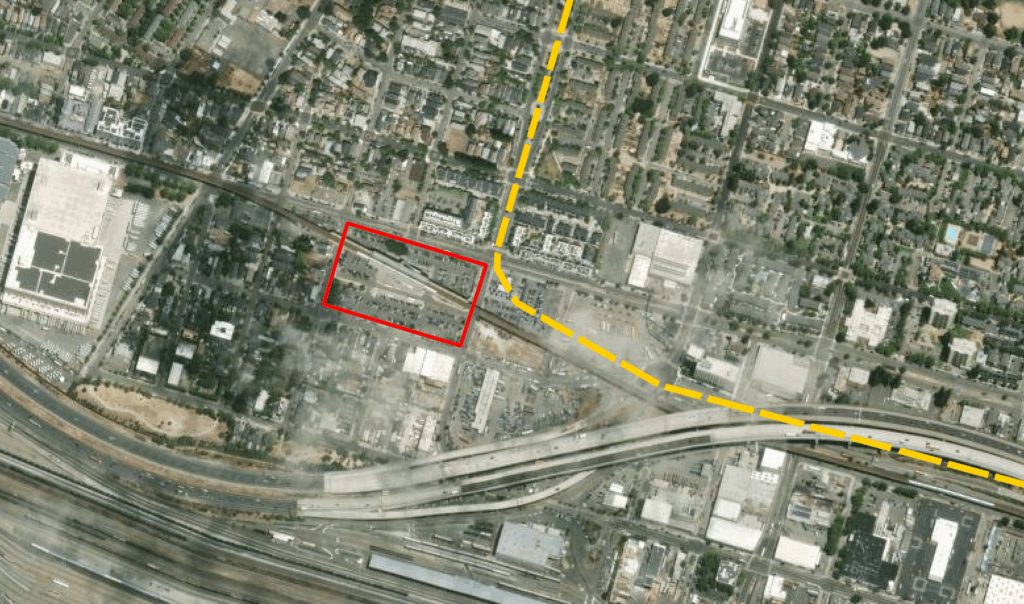
Mandela Station Development Area Proximity Map With Approximate Pathway of the Former Cyrpress Freeway, basemap via ArcGis Online, with edits by SF YIMBY
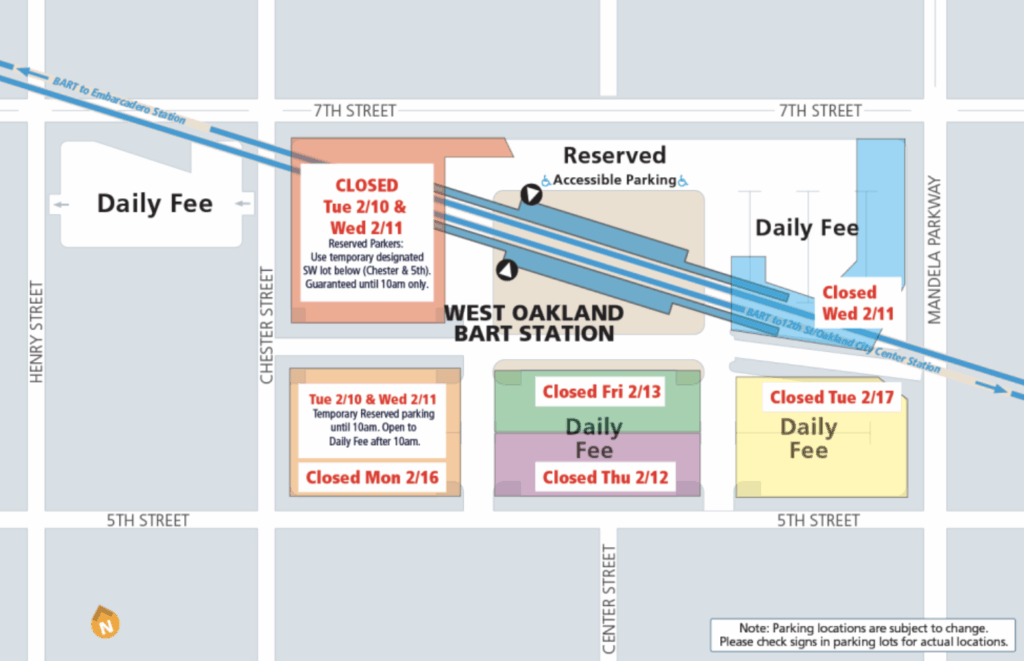
West Oakland BART Temporary Parking Lot Closures, image via BART
Subscribe to YIMBY’s daily e-mail

Follow YIMBYgram for real-time photo updates
Like YIMBY on Facebook
Follow YIMBY’s Twitter for the latest in YIMBYnews
Fantastic news! Sincerely hoping this jumpstarts the various stalled developments on non-BART owned parcels to the east of the station. The area between Mandela and Kirkham along 5th is extremely rough-looking recently. The vacant parcels in the area have all had various proposed developments over the last 5 years, but all have been stalled in some way or another.
Thorough article. Would be interested to know which project will be the first to start and what efforts the developers are taking to engage and include the Black community.
The modular housing is first, and units are already in production. I believe that means T3 is first?
Why on earth is there that massive of an office component is crazy. Downtown SF and Oakland certainly don’t need more space to plop that massive a complex here??
A site that’s directly connected to both locations, one stop away, and guaranteed to fill up if they can keep the neighborhood free from burning down RVs, why even waste the effort of a project that may never be filled? Maybe there’s an anchor teneat we all don’t know. At least they are putting massive job centers around transit. The rest of the Peninsula could never…
thanks for clarifying. i was wondering the same thing. numbers were confusing.
All of these BART area projects have been in the works for so long, and had so many missed start dates, that I am skeptical of the new news. I did hear that Oakland and BART are going to celebrate an actual groundbreaking by releasing a flock of flying pigs.
– West Oakland is a compelling investment opportunity. Demolishing portions of 980 and re-connecting West Oakland with downtown is at the very top of the list in Sacramento due to the guilt associated with how it impacted black people negatively. Projects like this will help West Oakland. Obviously, this neighborhood is extremely close to SF.
– BART needs these projects so badly to stabilize their financial situation. The powers that be need to buy BART another ten years for these projects to come online.
– 53,000 square feet of retail…they are planning for this to be the new retail hub of the area it appears. There is no destination zone in West Oakland for bars/restaurants etc…maybe this is it?
Agreed. Although I support the mass transit bailout this fall, I also think that BART needs to start thinking a bit more entrepreneur-like with its vast surface parking lots. Obviously, you’re going to need some parking – especially in the outer burbs, but inner city sites like this should be developed….and this scale makese sense for this location. There is a crap ton of low-density/vacant lots in West Oakland that oculd be repurposed. Also undgrounding freeways would go a long way.
The wheels are in motion for a bunch of them, at least 5-10. West Oakland is probably the biggest one, but North Berkeley and Ashby are very juicy as well.
There is a destination zone already. Prescott Market, Prescott Farmers Market, June’s Pizza, Brix Factory, Pacific Pipe, and Proyecto Diaz are all around West Grand and Mandela Parkway, with more coming.
That is not a dense, walkable destination at all. It’s very industrial.
For now. Seem the plan is to rebuild into something much nicer
That’s some crazy BART train! Perhaps the dream of a second transbay crossing will come true with blue liveried Caltrain consists coming through to West Oakland?
Americans are dumb for not thinking of this concept (high land use intensity that’s pedestrian oriented on top of rail stations) like decades ago. It’s so obvious. It tells you something about the caliber of our “experts” when a transit agency of all things thinks surface parking lots and park-n-ride is the best way to use valuable land next to the station. We are such a hick nation
I’ve never heard liberal progressives being called a Hick before. Thats pretty funny. At least real hicks don’t act like they know what’s best for urban transit areas
Interesting. I’m fully behind the TOD projects that BART is doing, but doing this in West Oakland feels like it will produce the gentrification NIMBYs have been warning about. Does a huge office tower in West Oakland really make sense?
True, but that horse is well outta the barn in West Oakland. I think most old-school West Oakland residents migrated to Fairfield, Stockton, and Sacramento back during the suprime mortgate meltdown. West Oakland is already pretty gentrified.
New housing doesn’t cause gentrification. A lack of housing causes gentrification. If these hundreds of units aren’t built, that only leads to more competition among renters for the existing units in the area, which drives prices up faster.
I don’t think that is true at all. If you are building only luxury market-rate housing in a working-class neighorhood that ordinarily does not have that much turnover, you are going to attract a lot of higher-income residents to said neighborhood. That creates the demand for expensive coffee shops, storefront gyms, restaurants, what have you. Those new businesses will typically pay more rent that your typical immigrant grocer, setting the dominoes in motion. As the neighborhood becomes wealthier and whiter, people who would not have considered living in the neighborhood before will move in. After a while, the transformation is complete and all of the available housing (except for subsidized and/or older rent-controlled housing) has turned over.
Not saying that not building anything will prevent a neighborhood from gentrifying, but let’s not get high on our own supply…YIMBY policies have real world consequences. That is why people in the Mission and a lot of other working-class Latine neighborhoods don’t buy YIMBY propaganda.
YIMBY policies mainly benefit wealthy newcomers and developers. Just look at Vancouver.
Building housing does not create displacement. Not building creates displacement. West Oakland is mostly single family homes which are the most expensive type of housing.
We have brand new market rate studios that start at $1300/mo on Mandela Parkway.
Maybe they can change the office component to something else. Not sure how the office market is doing in Oakland for A class space in a suburb. Maybe change it to senior housing, medical office, university, or something else.
I think they had plans for medical R&D and offices. I forget who exactly, but I want to say Stanford was interested. You’re right though, biotech office vacancy in Berkeley and Emeryville are 30-40% right now.
I recall that at some point the Planning applications switched a significant amount of space from office to biotech, and a potential rebranding to the “West Oakland – Emmeryville Biotech Corridor” or something like that. That is a brilliant idea. Even at the height of the pandemic there was less available biotech space than needed for a healthy market. The entire Bay Area needs more biotech space, and Emmeryville is already a super important hub. The industry is not viable for remote work, so building at a transit hub with housing and retail would be great. Could also re-activate all of the huge, unused/underused parcels on Mandela Parkway.
Good points made by G8787 and DJ. I don’t think the office building is designed to host major corporate offices. It’s more likely to be occupied by local-oriented tenants such as doctors’ offices, lawyers, and small businesses such as engineers, surveyors, and maritime-related service companies. If the building is to be 100 ft tall, that’s only about 7 stories. (Office buildings commonly run to 14 or 15 feet per floor.)
The tower could be mixed use residential & businesses. Might work a lot better then just straight up businesses.
Also I read elsewhere here in the comments that a studio on Mandela Parkway now goes for $1300?! Wow! I remember getting a 2 bedroom 3rd floor Victorian walk-up on 20th & West for only $1250 a month! How times have changed!
As a person who grew up in West Oakland and who mom still resides there. I look around today and see less and less of my people we have been pushed out, bought out and can’t afford to come back. If you haven’t lived here 40+ yrs, don’t speak on what West Oakland need. This part of Oakland was always prized but they had to get rid of the Black ppl who was monopolizing these neighborhoods. And they have succeeded,it’s sad sometimes going down streets you no longer recognize. I miss how everyone knew everyone that togetherness. I’m all for progress but not at the expense of others. R.I.P WESTSIDE!!
I am white and have owned a home in the heart of West Oakland for around 15 years. I have seen very little opposition to the purported gentrification of the neighborhood by my Black neighbors. I think the reason is that this is one of the sadly rare neighborhoods where the Black community owns the houses , possible even your mother. There is virtually no multi-unit residential, so very few renters are being displaced. In the last decade the value of these houses has gone from the mid $200k range to $700k+, which is a HUGE windfall for the homeowners. They are more than happy to be displaced for that much money. I number of my neighbors have relocated to suburbs (such as Antioch), even including a few churches which have moved. Other neighbors have moved to Oklahoma and Texas, where their extended families live. And it is made possible by the so called gentrification. This is the kind of healthy civic evolution that we should all be happy about.
There is virtually no commercial building stock in West Oakland, and thus virtually no services or restaurants (thankfully ameliorated to some extent by the recently opened excellent Prescott Market). The commercial buildings for this “once highly prosperous” neighborhood ran down 7th Street and on the 12 square block area now occupied by the US Post Office Oakland Processing and Distribution Center. After BART was put above ground down 7th St., wiping out the light rail line, stores, restaurants and clubs that lined the street, and the Post Office Center razed 12 square blocks of buildings in the name of “urban renewal”, there was virtually nothing left but historically protected Victorian single family homes and empty lots. The situation was not conducive to starting businesses or supporting neighborhood social infrastructure. We desperately need to have new retail space built near the BART station.
As for the new office space, my understanding is that the permits were converted to Life Sciences use for the bio-tech industry, which has a chronic shortage of supply throughout the Bay Area. The location is a short distance from Mission Bay and Emmeryville, both national hubs for the industry, making it a perfectly suited location for a sought after use.