
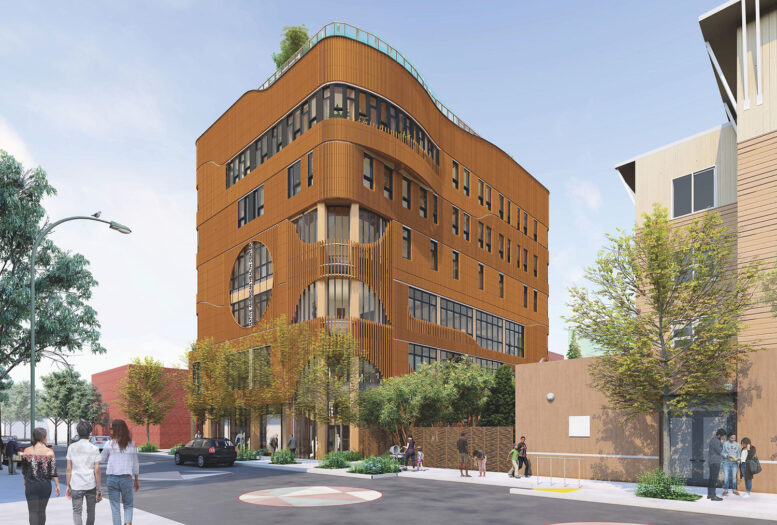
Modified plans have been filed for The Village, a planned six-story community center at 80 Julian Avenue in San Francisco’s Mission District. The latest application shows that the developer has taken advice from the Mayor’s Office of Housing and Community Development to increase the on-site affordable housing. The Friendship House Association of American Indians is listed as the property owner, working with Equity Community Builders.
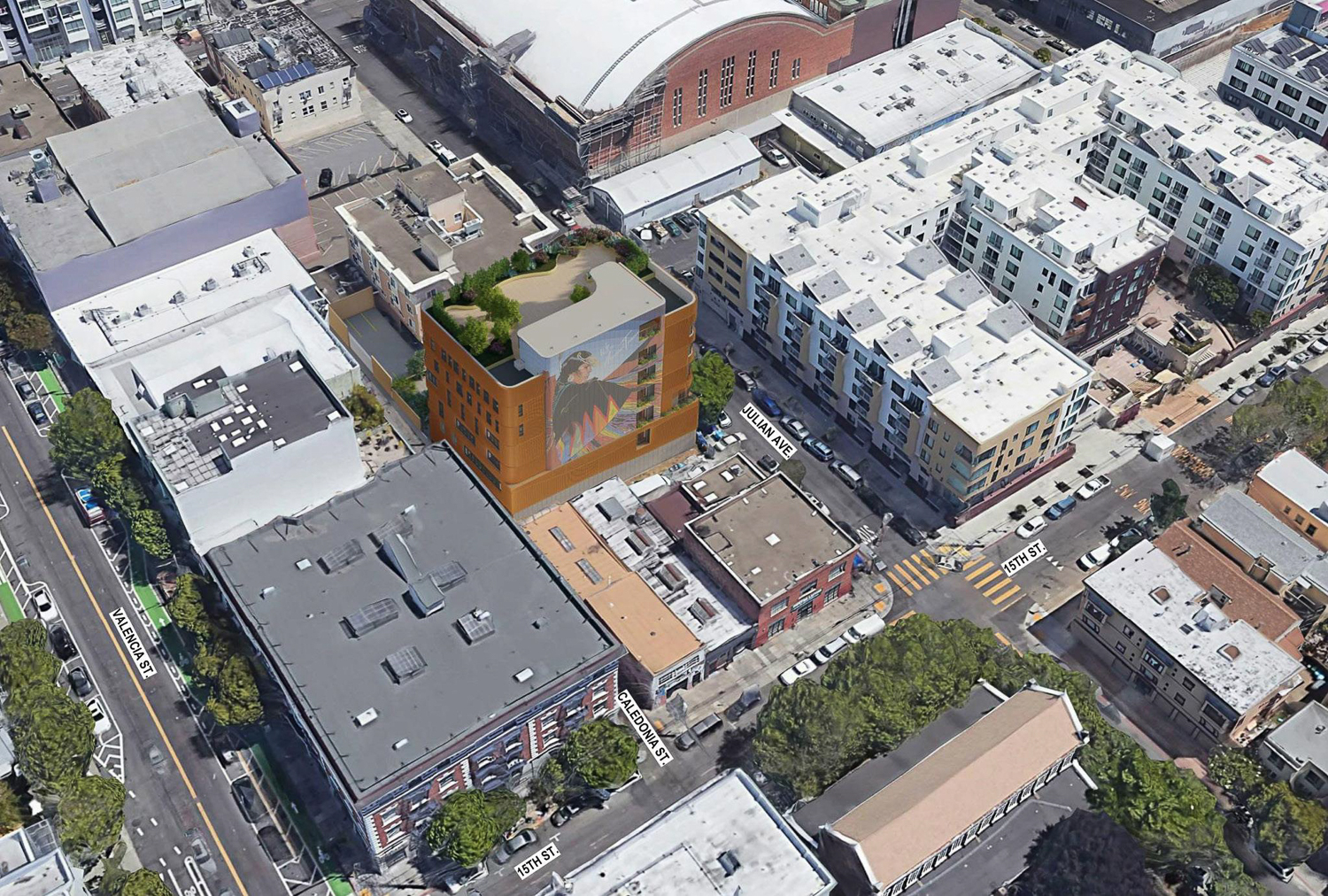
The Village SF at 80 Julian Avenue aerial view, rendering by PYATOK
The modification will reduce the medical facilities to a single floor, increase residential capacity from 21 units to 36 units, reduce the basement size, and add restaurant space on the ground floor. According to the recent application, part of these modifications were done “at the request of the MOHCD. The permanently supportive group living-style apartments will occupy the top three floors of the Village.
The proposed six-story structure is expected to yield around 41,500 square feet, including 19,390 square feet of housing, 6,000 square feet for a medical facility, 17,000 square feet for institutional space, and around 3,000 square feet for a ground-floor restaurant. Parking for 20 bicycles will be included.
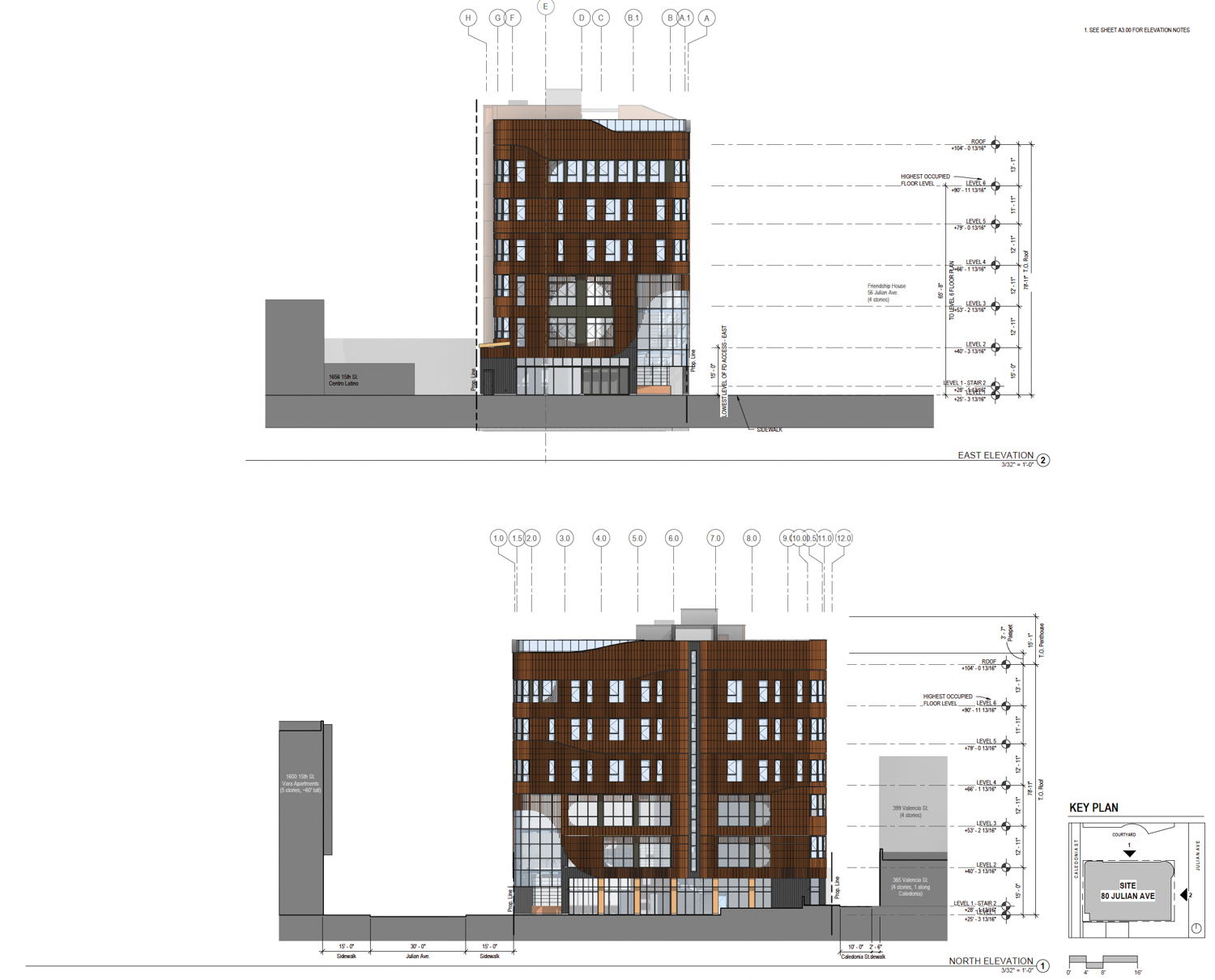
The Village facade elevations, illustration by PYATOK
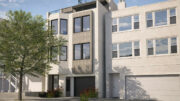
Oakland-based PYATOK is the project architect. New renderings have not been published, though two facade elevations and the application describe several changes to the exterior. Most notably, the fourth-floor windows will be changed to better accommodate residential use. The circular feature overlooking Julian Avenue will be pushed down one floor, and a setback will be added on the southern property line. The terracotta facade cladding is currently expected to remain the same, though the applicant does hint that “alternate materials remain under consideration.”
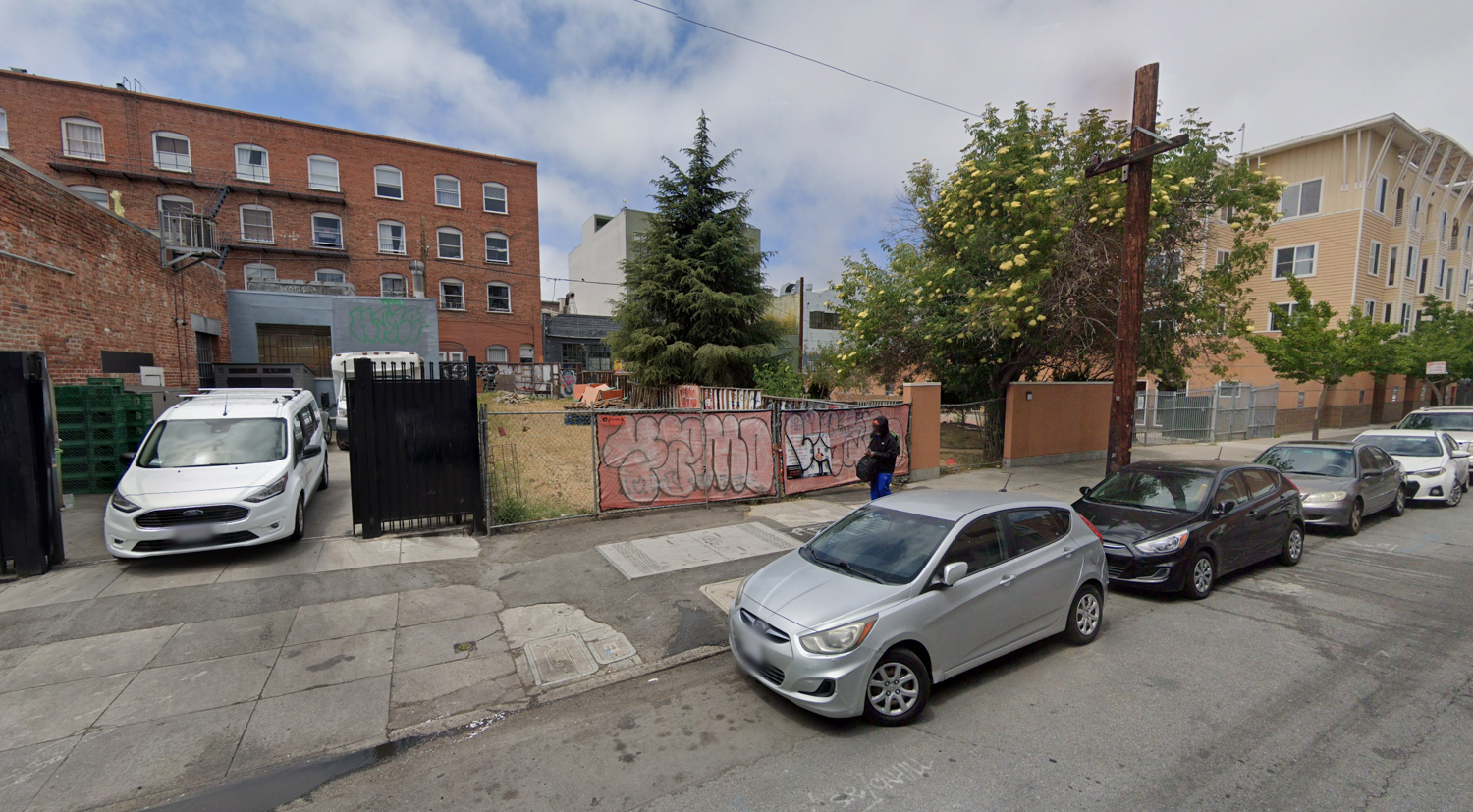
80 Julian Avenue, image via Google Street View
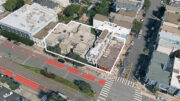
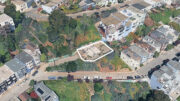
The 0.15-acre property is located along Julian Avenue between 14th Street and 15th Street. Future residents will be just over a block away from the BART Station. The project applicant estimates construction costs will be around $53 million, a figure that does not include all development costs.
Subscribe to YIMBY’s daily e-mail
Follow YIMBYgram for real-time photo updates
Like YIMBY on Facebook
Follow YIMBY’s Twitter for the latest in YIMBYnews
I love it! This design is really interesting; it will get rid of a parking lot, and Friendship House is a great organization. Build it!!!
I agree with Scotty…this time 😉.
Please include sufficient parking in new building developments. Many people—including individuals with disabilities, workers, families with children, and elderly residents—depend on cars for daily activities such as commuting to work, grocery shopping, and getting children to school.
Currently, street parking is extremely limited, and many residents cannot afford metered parking or frequent use of rideshare services. Without adequate parking, everyday life becomes significantly more difficult for those who rely on personal vehicles.
For these reasons, every new residential building should provide enough parking to meet the needs of its residents. Thanks
lol
And parking should be free on your birthday!! I also think people who ride bikes or are pedestrians should be taxed to help pay for more parking. It’s unfair people who drive have to take the burden of responsibility for the convenience of owning/using a car. It’s not like road damage, danger to bikes/peds, pollution (noise and air), detrimental land-use policy (which historically privileges parked cars) and the decline of our transit system isn’t already a burden on the city.
Thank you. I couldn’t agree more!!
This reply was for HM.
It is hilarious to me that most Yimbys believe that everyone should either be walking or riding a bicycle instead of owning a car. Seems to me that Yimbys believe that people should be tethered to their homes. And what about when there is inclement weather? Do you think everyone will just suck it up and buy a poncho to ride their bike to work or the store? If someone has two or three kids, are they supposed to get them all bicycles so they can accompany their kid to school on one, or if they have to go to the doctor, just stick a baby in a bicycle basket? I truly don’t think any Yimbys think of this. This goes for disabled folks…tooling around in a rainstorm? Oh, yeah, just get a rain poncho.
This project is two blocks from BART and some of the most convenient bus lines in the city, in one of the most walkable neighborhods in the Bay Area. Cabs and uber for errands and emergencies. Requiring a developer to spend millions to build parking for a few days of atrocious weather in a city famed for some of the farest climate conditions is overreach. Let the market decide.
Teri, to take your question seriously for a moment, the answer is yes. We do expect that in urban environments it’s possible for people to fulfill 90% of their travel needs with walking and public transit (biking is a nice optional thing that works in some places, but not all). Walking paths need to be safe and comfortable enough so that old folks and children can reliably get to where they need to go without risk of falling/accidents in all types of weather. Daily amenities (like grocery stores and parks) need to be accessible in a 10 minute or less walk. Monthly amenities (like doctor’s offices) need to be accessible by transit.
I’m surprised that someone from San Francisco would be so afraid of rain, but again to take your question seriously: yes, people should use umbrellas/ponchos/etc when it’s raining. If it isn’t safe for an older person to walk down the sidewalk in rain in shoes that a normal person could afford, it means that sidewalk isn’t safe enough period, and needs to be worked on.
People who are interested in urbanism take these concerns very seriously, and it’s been proven the world over that urbanism can work for children, the elderly, and the disabled. But it does require investments in the infrastructure to support them.
I’m not asking for free parking or special treatment. I’m highlighting that many residents across San Francisco—including healthcare workers, families, seniors, and people with mobility challenges—continue to rely on personal vehicles because current transit and infrastructure do not fully meet their needs.
In many neighborhoods, street parking is already constrained. Approving new housing without addressing how residents realistically access work, medical care, and daily necessities creates a clear mismatch between planning policy and actual living conditions.
From an equity and access standpoint, public infrastructure and land use decisions should serve all residents—not only those who can rely exclusively on transit or active transportation. Policies that overlook this risk disproportionately impacting working- and middle-class residents who do not have flexible schedules or viable alternatives.
As the city continues to add housing, developments should either incorporate adequate parking or be paired with enforceable solutions such as residential parking permit programs. Without this, the burden is effectively shifted onto existing residents and surrounding neighborhoods.
This is a common concern among residents across multiple neighborhoods, and balanced planning should reflect both long-term goals and present-day realities.
The building is located on a bart line and very close to the 14 bus. you have lost your mind.
lol
parking dramatically increases the cost of housing, many of those people you are concerned about wouldn’t be able to afford to live in a building that includes parking. If they do need a car, then they can choose to live in one of the many buildings across the country the do include parking. But in an urban location, close to many other transportation options, affordable housing developers would be crazy not to lean into the cost savings of reducing or removing parking onsite.
Bruh. Look around you and observe how people live once in a while. Literally 38% of Americans over the age of 10 either can’t drive, can’t afford a car, or have limited access to a car. Also, this isn’t the Chronicle, so what’s with the “oppressed Boomer” polemics?
As someone who lives near the Mission, I agree with HM about parking. Your snide and condescending comments just turn people off to your cause.
The entitlement the Mission has held with its “progressive” chokehold on SF’s development is what helps make it a hotspot of slumlords and poverty.
A multi billion dollar transit system consistently on the verge of collapse and there’s blocks of abandoned lots, structures held up in redevelopment for decades, shells of buildings collapsing on themselves. It’s pathetic.
We want to prevent all means of gentrification, but then pretend inflation has not existed for the past 30 years. Advocates pushing for brighter tomorrow but ignore the surefire way of adding more capital for social services. Now we’re at the dead end and budgets are getting cut. MUNI and BART have to raise taxes, again, to prevent catastrophic cuts to the system. You can only raise minimum wage so much before real estate values eat us alive or rent controlled properties that haven’t had the budget for essential repairs end up falling apart or worse.
If you want to live in a city, you need to start acting the part. No improvement can exist with the current status quo. The city can’t afford its current trajectory without pricing out more of the working class. We’re eating ourselves alive in this rat race and somehow the billionaire class has managed to convince the working class that building new housing is the same enemy. Parking is a tax on everyone, especially when it’s government funded.
The irony is that every time someone cries “what about cars” it’s not only offensive but also selfish and regressive. Cars/car owners are privileged more than homeowners at this point and it’s clear that no matter how much space, priority or “free” there is, it’s still not enough.
I totally agree that finding parking in the city (not just the Mission or this city specifically) sucks, but it’s literally everywhere you look and is only maxed because TOO MANY people rely on using CARS.
We live in on of the densest, easy to get around without a car places in the country… even if you’re an age-ed person, disabled, or a child.
We do need to continue to invest in infrastructure that makes walking safer for children, the elderly, and the disabled. However, we have pretty incredible walking/transit infrastructure already in some parts of San Francisco, and I don’t think it makes sense to be adding car infrastructure in those parts.
I hope some passionate arguments in these comments don’t turn you off from the idea of urbanism completely! Please see my response to HM’s post.
To the seniors “needing” to drive, please call SFMTA Paratransit at 415-285-6945 for a ride. They’ll come to your door and drop you off directly at your destination. No more walking blocks from your parking space!
The residents will be mistly recovering addicts. So they might want cars, but who cares. Getting them a sober, friendly place to live and make friends is what is important. The biggest issue is that the recovering addicts will be so close to open drug markets and dealers that most will relapse due to how easy it is to get hard drugs right out front! My fam lives on Julian and 15-16th
I love the design, but the planning board is probably going to force them to change it to include more facade colors or something.
This is an architectural design comment:
The facade concept with slats and curved lines in plan is potentially very interesting, but there are too many different types of window openings. It looks slightly crazy….in a bad way. You need one or two types of openings that are part of a coherent design language. Get rid of the circular and half-circle bending around the corner, and use horizontal bands with a downward slope to full-height windows, plus vertical slot windows that derive from the mullion dimensions in the window bands. The slight color differences between floor levels on the elevation are not helpful. Use one color for the slat cladding.