
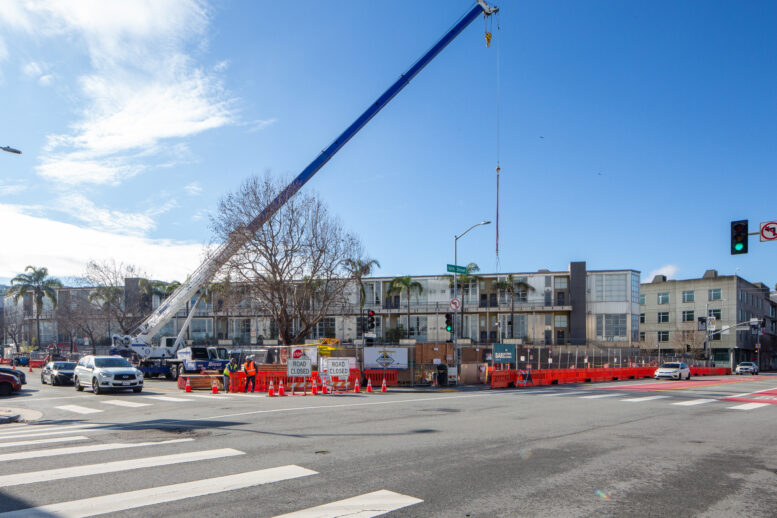
Construction is underway for the fully-affordable 11-story development at 300 De Haro Street in Potrero Hill, San Francisco. Foundation work is underway, with the first crane segment visible on site. DM Development and MRK Partners are jointly responsible for the project.
The project has evolved significantly over the years, beginning with a 2020 application for a seven-story mixed-use development with 290 group housing units. By 2021, DM Development’s plans increased to 12 floors with 450 group-housing units, of which 184 would be deed-restricted as affordable.
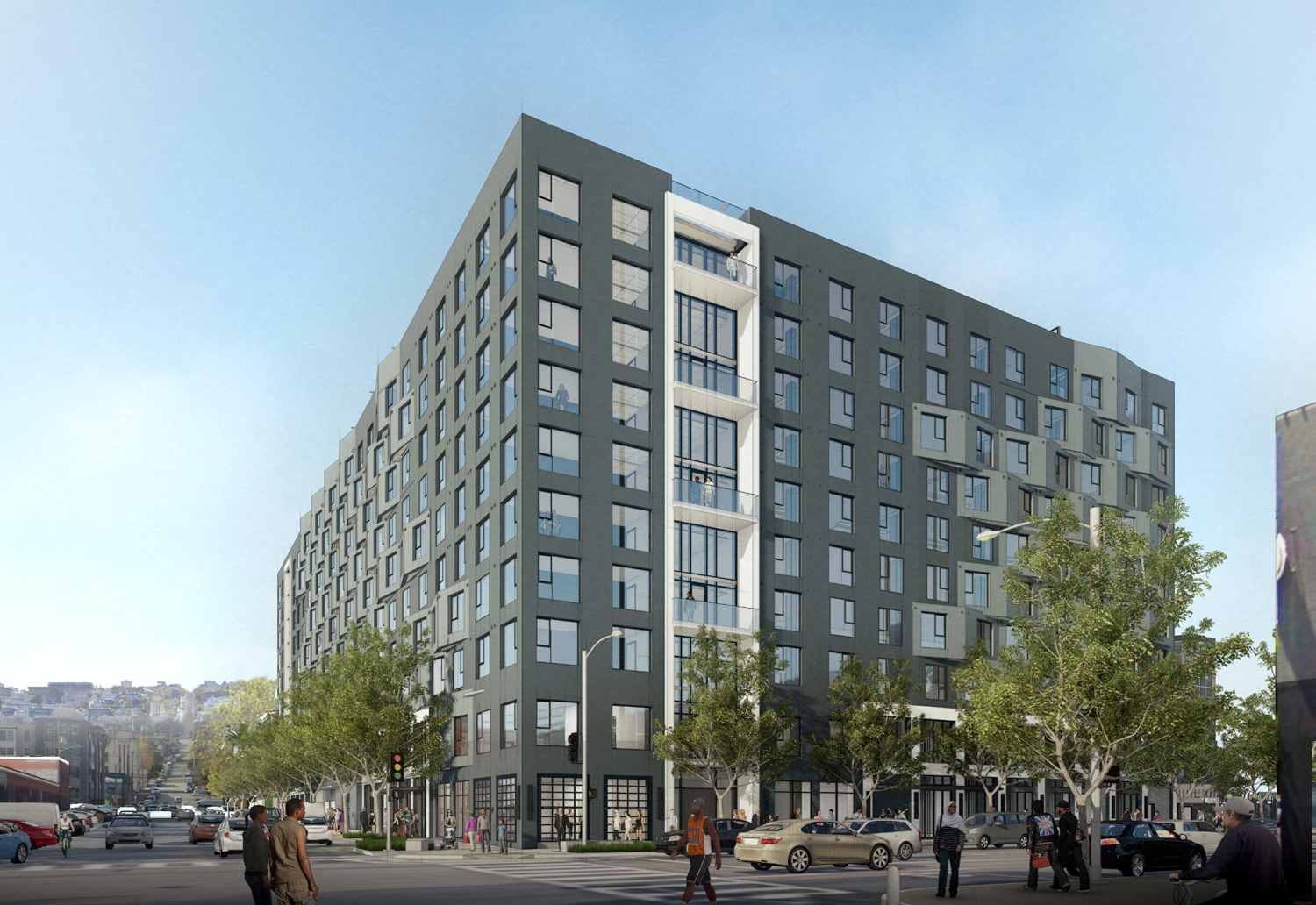
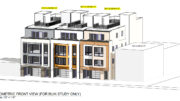
300 De Haro Street updated design, rendering by BAR Architects & Interiors
In mid-2024, the final plans were submitted to transition to an 11-story, fully affordable development with 425 studios. The 425 units will be deed-restricted as affordable for households earning between 30-70% of the area’s median income. Construction started on the project with a groundbreaking ceremony last August.
The roughly 120-foot-tall structure is expected to yield around 189,980 square feet, including 425 studio apartments and roughly 6,000 square feet of ground-floor retail. Each unit will be set with a private bathroom and kitchenette. Landscaping improvements will include a patio extension from the sidewalk along De Haro Street, a second-floor courtyard, and a rooftop deck. Residential amenities will include lounges on the 2nd and 11th floors, on-site laundry, a fitness center, and a second-floor community kitchen.
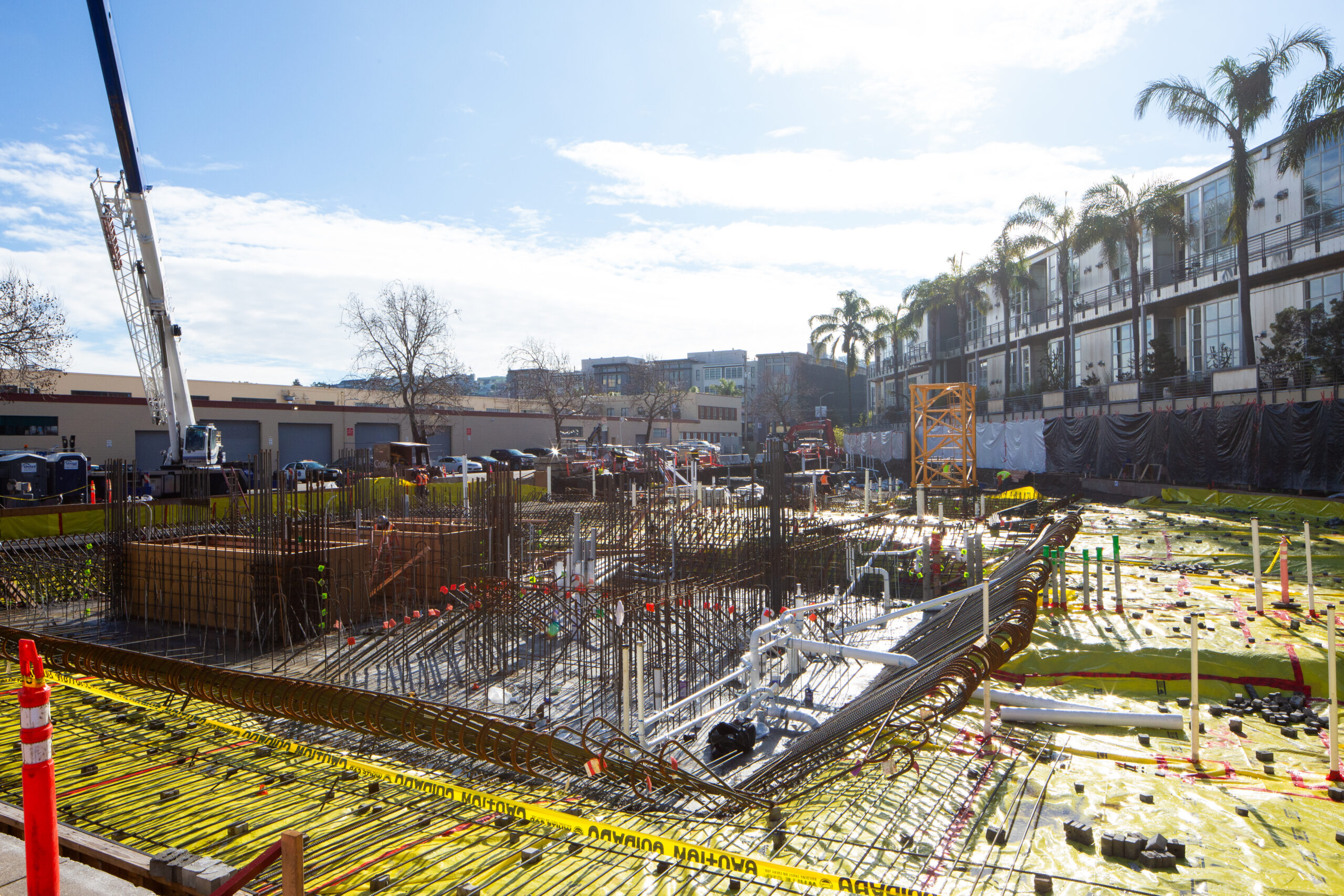
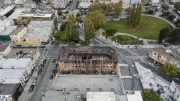
300 De Haro foundation view, image by Andrew Campbell Nelson
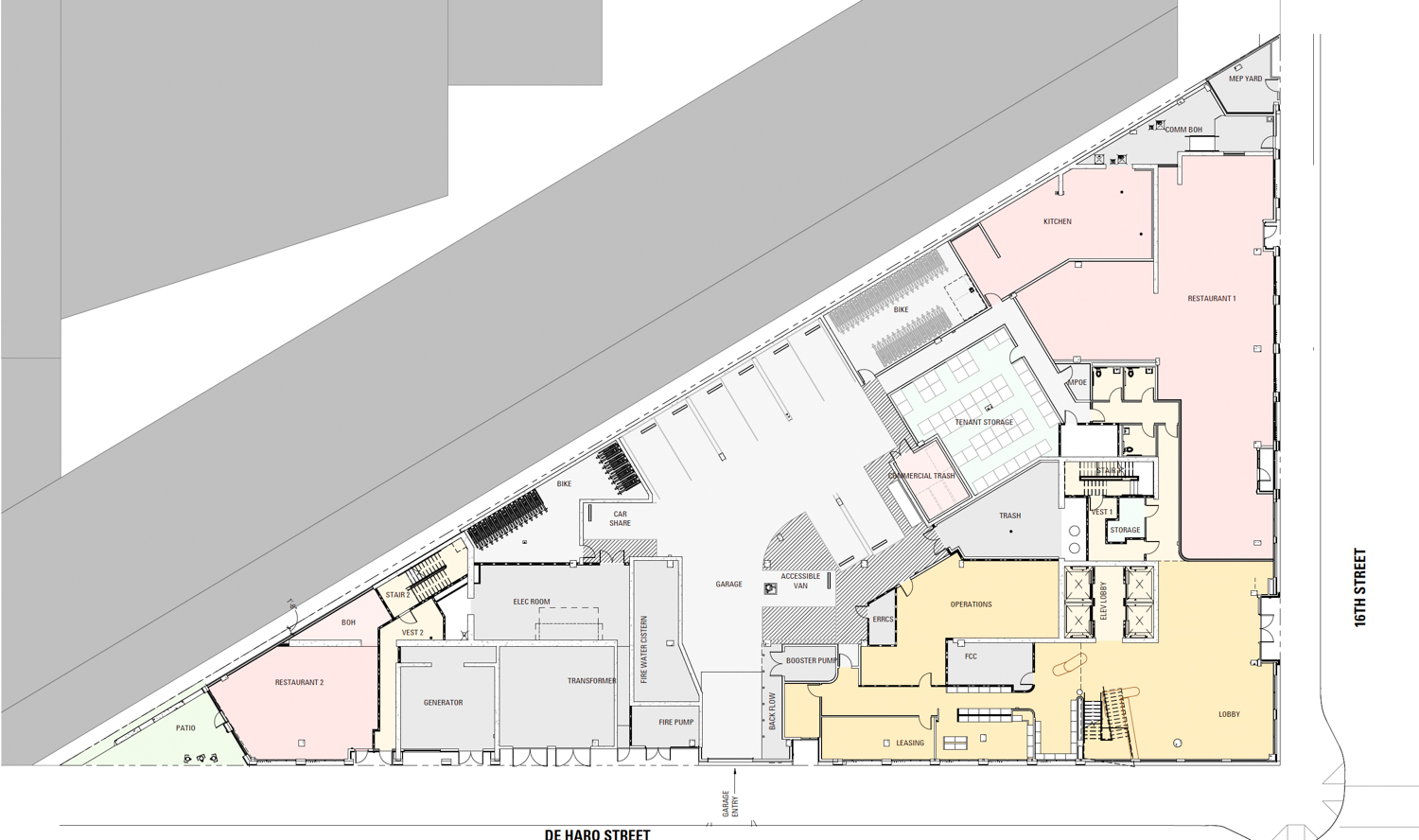
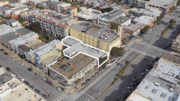
300 De Haro Street ground-level floor plan, illustration by BAR Architects & Interiors
The 0.62-acre parcel is a triangular corner lot bound by De Haro Street and 16th Street. The property is near the California College of the Arts campus, which is scheduled to close in 2027 and be reoccupied by Vanderbilt University as the California College of the Arts Institute at Vanderbilt.
Thompson Builders is the general contractor, with design by BAR Architects & Interiors. The development team expected the building to open as early as mid-2027.
Subscribe to YIMBY’s daily e-mail
Follow YIMBYgram for real-time photo updates
Like YIMBY on Facebook
Follow YIMBY’s Twitter for the latest in YIMBYnews
“Fully affordable” to me always reads as “future run-down projects.” I think neighborhoods function better when people of lower economic means are more incorporated into the fabric of the community.
I’ve been glad to see this development take shape as the footings are poured. But I gotta say that while I don’t agree with you that “poor people = slum” (I know that’s not what you said but it distills it), I do agree this is a very large development that will be mostly people of similar life condition, which makes it harder to fit into an existing community. The fact that the entire building will be studios means there won’t be families, there (probably) won’t be children, there won’t even be that many couples. A greater variety of unit sizes = different ages and family sizes which seems to help a development fit seamlessly into an existing area.
The YIMBY shows his true colors….
Not sure what you’re getting at, but 425 studios is going to be a whole lot of single people (with some couples). I wish the building had a mix of studio, one-bedroom, and a smattering of two- and three-bedroom. Nothing helps make an area more vibrant than parents taking kids to the park, kids playing, couples walking together etc. But regardless, glad to see that triangle finally going up!
Right. I wasn’t referring to you. I think this is a good project. I was referring to Snazz’s overtly classist (and probably racist too) jibe toward an all-affordable housing development. You see it all the time here.
I’m not sure if I didn’t articulate my thoughts well, if you misinterpreted them, or some combination of both. I think we should have mixed communities of all of us living in the same communities, going to the same schools, etc. It feels like we set people up for failure when we try to stick all the “poor” people in one place instead of sharing the same spaces.
I’d much rather have five buildings with 20% affordable units than one 100% affordable place and four market-rate buildings. I don’t think that’s a healthy dynamic for anyone.
I think brucemcdou raises another good point. I’m not in favor of all studies or senior housing, or any of that other sort of thing either, for the same reasons. I don’t want to live in a place that has people of just one age or demographic or ethnicity, and I don’t think it’s good for society, either.
Finally, while I’d make different choices about this if I were in charge, I’d much rather have this new housing than none at all, just because I’m waiting for the perfect project to come along. We need more housing at every size and price range if we’re going to ease our housing crisis.
Living near several 100% affordable developments. There’s a lot of personal trash thrown out of cars. As well as double parking and parking in red zones. One new building near me doesn’t have a loading zone, so everyone parks in the red and blocks one lane of the road. The developments should be required to pick up trash within a 1-2 block radius of the building and better plan for temporary parking. Other than that, a new building is better than a empty lot or abandoned building.
It all depends on the Area Median Income (AMI) of the building. This building is 30-70%, which equates to 32K to 76K for a single person. For what it’s worth, a full time minimum wage worker like a cashier makes about $40K a year.
The affordable designation here is 30-70% AMI which will include some very low income people, but also lots of people who make pretty decent money but are priced out of SF. These buildings are mixed income by design, you are just assuming that affordable is a blanket term for bad people or something. Many of the grants and bonds that pay for affordable housing dictate the income mix allowed so its often not even in the control of the developers or community leaders. Finally, SF has plenty of rich people and schools filled with rich kids. We need more housing for poor and working class people, thats the income mix that is missing!
At an average unit size of 300 gsf, calling these “studios” is a bit disingenuous. They aren’t really group housing units either, with limited common areas and one community kitchen? And the website mentions families living here? Imagine families sharing a single murphy bed. It’s an SRO building masquerading as something else because SRO’s aren’t permitted there.
I see no mention of any parking for cars – even less than usual for your SF projects.
The YIMBY contention that San Franciscan are/should give up driving are, seemingly unfounded.
Currently, 70% of SF households have at least 1 car.
Public transit – MUNI, BART – are constantly under financial stress.
The auto industry is still doing banner business.
I’m a lifelong resident & native son who gave-up my car 25 years ago and it works for me. But, I would assert that most people won’t buy it for some time to come.
“The auto industry is still doing banner business.”
Totally disagree.
– Waymo / self-driving cars are coming
– Uber/Lyft
– E-Bikes (own and rent)
– Electric Scooters (own and rent)
– SF opened its first underground subway in 50 years a few years ago
– Caltrain was electrified recently
– Remote/online work killing commutes
The need for a car has never been lower.